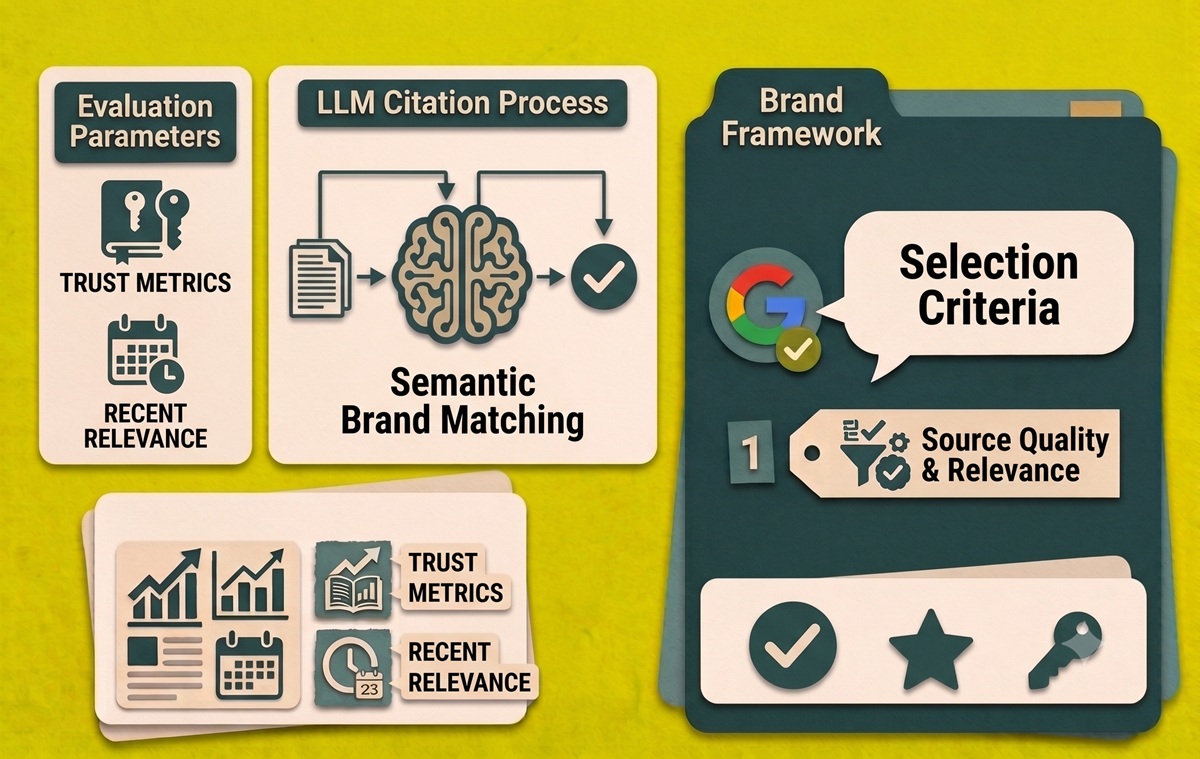
LLM brand mentions can shape early shortlists before any website visit. Weak AI brand visibility can leave competitors inside that first comparison. Buyers ask ChatGPT, Gemini, Perplexity, Copilot, Claude, and Google for options. Named companies receive attention before any organic search click.
Brand recommendations start with candidates available for each specific request. A brand can enter through model knowledge, external retrieval, or shopping records. Request constraints narrow that pool before final selection begins. Providers publish some inputs, while many internal selection rules remain private.
A large language model can supply one component inside a wider assistant. Search layers, product records, user preferences, and policy controls may also participate. Each named surface documents a different combination.
Does an AI assistant compare every brand?
Brand recommendation starts with candidates available for the current request.
Candidate entry → Conditional filtering → Request match → Selection → Recommendation
Candidate entry creates the initial comparison pool. Conditional filtering applies where policy or eligibility controls remove options. Request matching compares remaining candidates against current user constraints. Selection determines which candidates appear as suitable recommendations.
OpenAI shopping documentation lists safety standards and product policies among shopping selection inputs. Hou et al. tested LLM ranking over candidate lists supplied through separate generation methods. Their ECIR 2024 experiments found popularity and position bias across selected tasks. Provider documentation exposes different system details, with no shared sequence. Model recall alone offers no proof of recommendation likelihood.
What happens before a brand appears in an AI answer?
A brand can pass through seven stages before appearing in an answer. Products may combine stages or repeat earlier searches. Providers keep their full selection systems private.
1. Read the request
First, the product identifies category, place, price, features, audience, and exclusions. Small wording changes can move one need above another.
2. Choose an information source
Next, the product chooses model memory, web search, connected records, or several sources. Current questions can require newer evidence from public sources. A poor source choice can remove useful brands early.
3. Build the first shortlist
Model memory recalls names, while search tools find relevant records. These sources create the first brand shortlist. Missing companies receive no comparison against buyer requirements.
4. Filter the available evidence
Available material must match the request and product policies. Old, blocked, weak, or unrelated records can lose value. Finding a page never proves final brand selection.
5. Compare the remaining brands
Price, location, features, availability, and risk narrow the shortlist. Required details can remove a famous but unsuitable company. Strong recall cannot replace a missing service or feature. Buyer wording controls which tradeoffs receive priority.
6. Write one possible answer
The final answer has limited space for remaining brands. Another response can contain a different eligible brand mix.
7. Add sources where supported
Some products link sources that support parts of the answer. The cited publisher may differ from the named company. A link shows which source supports a statement. It never proves endorsement, purchase intent, or website traffic.
Retrieval augmented generation research shows how retrieved records can support generated responses. Dense Passage Retrieval research tests finding relevant passages for open questions. Both studies cover technical design without exposing private commercial ranking rules.
Each stage needs its own evidence and test. Fixing later stages first spends money without restoring shortlist entry. Follow the sequence before ordering more content or publicity.
How does a brand enter the candidate set?
Brand candidates can come from three broad information sources.
Model knowledge
Training can leave factual associations inside model parameters. Kandpal et al. linked factual accuracy with relevant pretraining exposure across several datasets. Retrieval reduced dependence on sparse exposure inside those experiments. Commercial brand selection fell outside the research scope.
Web retrieval
Runtime information retrieval can add external evidence when a system supports search. The PopQA study found retrieval valuable for less-popular factual knowledge across entity-centered questions. Commercial brand ranking fell outside that research design. Retrieval can expand available information before later selection.
Commerce data
Shopping systems can receive detailed product records from brands and retailers. OpenAI shopping documentation lists price, reviews, descriptions, metadata, third-party content, and prior model responses. The Google Shopping Graph receives names, descriptions, prices, images, and reviews. Google can use those records across generative product recommendation experiences. Product records supply attributes for later shopping comparisons.
Why can one request favor a different brand?
One request can favor a brand another request excludes. Additional constraints change which candidate attributes receive priority.
Hypothetical broad request
Best CRM
Hypothetical constrained request
CRM for a five-person Indian SaaS team needing WhatsApp under ₹5,000 monthly
The constrained request adds several candidate filters:
- Budget range
- Country or service area
- Company size
- Required integrations
- Product availability
Geography can exclude options unavailable in the relevant market. Budget can remove expensive candidates before deeper comparison.
Google supports favourite-brand preferences across the US, Canada, Australia, and India. Favourite-brand saving applies within some shopping categories. Google shopping preferences can increase saved-brand appearances across relevant results.
ChatGPT Search can rewrite queries using location and relevant Memory when applicable. OpenAI documents one or more targeted searches from one request. Changing constraints can produce distinct recommendation outcomes. A single score across users would erase those differences.
Shopping platforms expose different product recommendation inputs
Current shopping documentation names several product-selection inputs across the reviewed surfaces. Those findings apply only to the named commerce surfaces.
| Surface | Documented selection inputs | Personalization context | Scope |
|---|---|---|---|
| ChatGPT shopping | Query context, price, reviews, metadata, prior model response, policies | Memory, custom instructions | ChatGPT shopping |
| Google Shopping | Relevance, ratings, price, product features | Searches, views, browsing activity, saved preferences | Google shopping experiences |
| Perplexity Instant Buy | Authority and relevance, availability, reviews, pricing, specifications | Previous searches, interactions, saved preferences | US Instant Buy |
| Microsoft Copilot shopping | Prompt, engagement likelihood from historical performance, merchant data | None specified separately | Copilot shopping markets |
Google separates Top recommendation inputs from broader personalization context. Perplexity uses its own authority-and-relevance wording for Instant Buy.
Evidence basis: Provider documentation supports the comparison. Matched cross-platform recommendation testing falls outside article scope.
Paid placement
- OpenAI separates shopping product results from advertising placements.
- Google Shopping labels sponsored listings separately from unpaid Top recommendations.
- Perplexity Instant Buy describes organic product listings as algorithmically selected and unsponsored.
- Microsoft Copilot shopping identifies sponsored links separately from other qualifying suggestions.
Product choice and seller choice can split
Product recommendation and merchant ordering can follow separate criteria. OpenAI shopping documentation separates product surfacing from later merchant ranking. Merchant ranking can consider availability, price, quality, and primary-seller status. One recommended product can appear beside several eligible merchant options.
Shopping evidence leaves service-company selection unresolved
Reviewed provider documents expose no comparable service-company selection formula. Shopping inputs cannot certify agency, clinic, or consultancy selection rules.
Where common AI ranking factor claims break down
Many ranking-factor claims jump from narrow evidence to broad conclusions. Before treating a signal as a recommendation factor, match its stage, outcome, surface, and evidence.
Popularity can affect recall without guaranteeing recommendation
Kandpal et al. connect greater pretraining exposure with stronger factual recall across QA datasets. Hou et al. report popularity bias across selected candidate-ranking experiments. Lichtenberg et al. found lower popularity bias than traditional recommenders in a movie setup. Lichtenberg remains a preprint from a movie-recommendation setup.
Google shopping recommendations can reflect popularity or broader web trends. Personal activity can influence results under supported personalization controls. The evidence spans different systems, tasks, and measured outcomes. Popularity can influence some stages without controlling every recommendation.
Search rank can affect retrieval without becoming recommendation rank
Search position ≠ Recommendation position
Google uses core Search ranking systems for AI retrieval. Through query fan-out, Google can issue related searches across several subtopics.
ChatGPT Search can rewrite one request into several targeted searches when needed. OpenAI documents multiple search providers, including Bing and Shopify.
For these search-enabled surfaces, retrieval determines which external information becomes available. Final recommendation order remains a separate, partly private decision.
One platform input cannot become a universal ranking weight
Reviews and product metadata appear in named shopping documentation. Their documented role applies only to those commerce surfaces. Across reviewed provider documents, no universal recommendation rule appeared for Reddit, backlinks, or Wikipedia.
Google AI Search documentation lists no extra technical requirements for AI Overviews and AI Mode.
Research boundary
Model-context position and webpage position answer different technical questions.
Lost in the Middle tested information positions inside long model contexts.
Its findings cannot establish webpage placement effects on recommendation visibility.
A mention, citation, recommendation and referral are four different outcomes
| Outcome | What happened | Useful metric |
| Mention | Brand name appears | Mention rate |
| Citation | Source supports answer content | Citation rate |
| Recommendation | Brand receives preference for the request | Recommendation rate |
| Referral | User visits a destination from the AI surface | Referral sessions |
An answer can mention one brand while citing another source. A recommendation can appear without producing any outbound referral. Citation studies therefore cannot establish recommendation effects across different outcomes.
One prompt captures one result; visibility needs repeated testing
One response records one observation under one prompt and user condition. Useful recommendation tests preserve three groups of conditions.
- Prompt state: buyer intent, prompt variant, platform surface
- User state: location, account state, personalization state
- Observation state: date, recommended brands, order, cited sources
POSIX found sensitivity across intent-preserving prompt variations in tested open-source models. Paraphrasing showed high sensitivity during its open-ended generation experiments.
A WASSA 2026 study found different stability patterns across five models using deterministic opinion prompts. EMNLP 2025 research found scoring methods can inflate measured prompt sensitivity. Model-based scoring reduced variance across several benchmark experiments.
Together, those findings support relevant prompt variation without a universal sample count. Recommendation visibility measurement needs separate records across prompt, platform, and user states.
Which recommendation inputs can a brand influence?
Brands control their published facts, product feeds, and crawlable pages. Providers control private selection rules, experiments, and final recommendation behavior.
| Brand can influence | Outside direct brand control |
| Brand-owned product and service descriptions | Undisclosed selection or ranking rules |
| Brand-supplied product attributes | Internal candidate thresholds |
| Brand-managed price and availability data where applicable | Provider experiments |
| Own crawlable public pages and product feeds | User personalization |
| Evidence supporting capability claims | Historical training exposure |
| Measurement design | Final recommendation placement |
When provider selection logic remains private, measure recommendation outcomes and report the limits.
SEO Noida can review mentions, citations, recommendations, and factual accuracy. Book a free AI SEO audit for an ordered diagnosis. You receive priorities, evidence, and limits without a guaranteed result.
Frequently Asked Questions
Can an AI system invent or misdescribe a brand?
AI systems can invent or misdescribe brand facts. Research on AI uncertainty tests ways to detect unreliable answers.
Can negative reviews make an AI system mention my brand?
Negative reviews can enter supported searches or shopping comparisons. Such reviews may provide evidence while reducing buyer trust. No provider publishes one review rule covering every answer.
Does asking in Hindi change which brands appear?
Hindi wording can produce different search terms and sources. Hindi-English questions may also change which local brands appear. European multilingual brand research found differences across its tested markets. Its sample excluded Hindi and Indian buyers, requiring local testing.
Can safety rules remove a brand from recommendations?
Safety policies can remove products from some recommendation categories. OpenAI shopping documentation lists safety standards and product policies among inputs. Other providers can publish different product limits. Every policy applies only within its named product. Check current documents before publishing category claims.
How quickly do LLMs update brand information?
Search-enabled answers can retrieve newer public brand information. Model memory follows provider training and release schedules. Companies cannot control those private release schedules. Old facts may remain inside memory-based answers. Current public pages can support newer search results. Test relevant search modes after major company changes.
Can paid advertising influence an organic AI mention?
OpenAI separates documented shopping results from advertising placements. That policy covers only documented OpenAI products. Paid placement cannot guarantee an organic brand mention. Other providers may publish different policies later. Check current provider rules before buying advertising. Keep paid and organic visibility results separate. Reject any agency selling guaranteed organic mentions.

Manish Singh is Head of Generative AI at SEO Noida and has 14+ years of experience in SEO, UX, and digital marketing. He focuses on how Google and AI platforms find, interpret, and cite web content. His articles cover AI SEO, GEO, AEO, LLM SEO, entity optimization, content architecture, and visibility measurement, drawing on website audits and campaign work.