Which Factors Improve AI Content Retrieval?
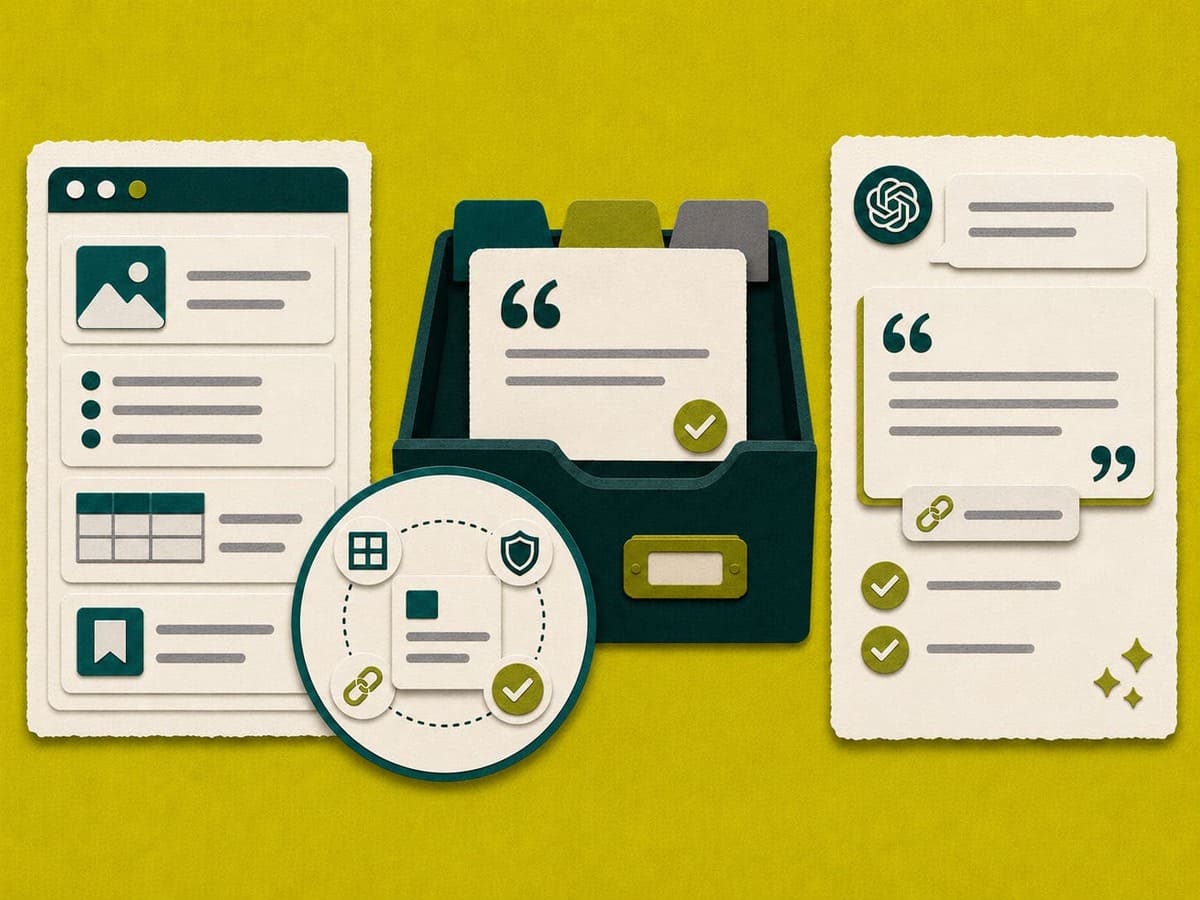
Retrieval starts with access, relevance, and a complete answer passage. The page must permit crawling and expose useful text inside rendered HTML. One passage should answer one buyer question without needing nearby paragraphs.
Five separate outcomes shape AI visibility:
- Crawlable content permits approved bots to fetch required page resources
- Indexable content meets storage, canonical, status, and preview requirements
- Retrievable content matches one query through words, meaning, and context
- Citeable content offers stronger support than competing retrieved sources
- Quotable content carries one exact claim with scope and proof
Treat each outcome as a separate checkpoint during diagnosis. Crawl access alone never proves indexing, retrieval, citation, or quotation. A retrieved source may shape an answer without receiving a visible citation.
How Does Content Move From Crawling to Quotation?
Content passes several technical and editorial checks before any quotation appears. Commercial systems hide their exact pipelines, yet public research supports the broad sequence.
- Access lets an approved crawler fetch the page and resources.
- Rendering exposes headings, text, links, facts, and schema markup.
- Indexing stores the selected canonical page for possible retrieval.
- Interpretation identifies topics, entities, relationships, claims, and dates.
- Retrieval matches a passage against the query or related subquery.
- Reranking compares that passage against other possible sources.
- Generation builds an answer using selected context and model knowledge.
- Citation connects chosen claims with one or more supporting sources.
- Quotation reuses exact wording when that wording serves the response.
Follow the complete sequence when diagnosing weak AI visibility. Editorial changes waste resources when crawlers cannot access important text. Technical access alone cannot rescue vague, unsupported, or duplicated web passages.
Which Google Requirements Affect AI Retrieval?
Google applies normal search requirements to AI Overviews and AI Mode. Its AI features documentation currently requires an indexed page eligible for snippets. Google needs no special schema or separate AI text file.
Important content should remain visible as text and reachable through internal links. Schema markup should match facts visible on the page. Google also confirms query fan-out across related subtopics and data sources. Separate pages can answer separate buyer questions across that wider search process.
Google preview controls can remove valuable answer text from AI features. The robots meta documentation describes three important controls:
nosnippetblocks text previews from the complete pagemax-snippetlimits the available length for extracted previewsdata-nosnippetremoves selected page sections from preview use
Audit those controls before rewriting any answer passage. A useful passage hidden from previews cannot support Google AI answers.
Which Crawlers Control AI Search Access?
Search crawlers and training crawlers perform different jobs. Blocking the wrong crawler can remove search access without changing training access.
OpenAI Crawlers
The OpenAI crawler documentation assigns search visibility to OAI-SearchBot. GPTBot covers possible model training use separately. ChatGPT-User supports user-requested visits and never controls automatic search eligibility.
Perplexity Crawlers
The Perplexity crawler documentation connects PerplexityBot with search result discovery. Perplexity-User fetches pages after direct user requests. Firewalls must permit verified user agents and current published IP ranges.
Anthropic Crawlers
The Anthropic crawler documentation separates three access jobs. Claude-SearchBot supports search quality, while ClaudeBot covers possible training use. Claude-User retrieves web content after user requests inside Claude.
Check robots rules, firewall logs, CDN rules, and verified IP ranges together. User-agent permission alone cannot bypass an infrastructure block. The IndexNow protocol reports changed URLs to participating engines. Submission confirms receipt, never automatic indexing, retrieval, ranking, or citation.
How Should JavaScript Content Reach AI Crawlers?
Critical answer content should appear inside rendered HTML. The Google JavaScript documentation recommends server-side rendering or pre-rendering for wider crawler access. Google can render JavaScript, while several other bots cannot execute it.
Compare raw HTML with the final rendered page. Confirm that headings, answers, prices, dates, authors, and citations remain visible. Test essential facts without login walls, clicks, tabs, or delayed content requests.
Use alternatives for files and visual content. Videos need transcripts, while charts need captions and supporting text. Scanned PDFs need searchable text recognition and a useful HTML summary.
What Makes a Passage Retrieval Ready?
A retrieval-ready passage answers one query without missing context. It should contain six elements within the same local block:
- A named subject identifying the company, person, product, or place
- One direct answer matching the main query behind that section
- Necessary scope covering time, place, audience, unit, or product
- Specific proof connected with a traceable primary source
- Low ambiguity across names, pronouns, numbers, and measurement units
- Distinct information that adds value beyond competing pages
Compare these two example statements:
Weak statement: Revenue grew 28 percent last year.
Improved statement: Acme India revenue grew 28 percent during 2025.
The statement names the subject, value, and period. A verified source and method would make the claim stronger. The complete passage can survive extraction without losing its basic meaning.
What Makes a Claim Quote Ready?
A quote-ready claim keeps its meaning after separation from surrounding text. Name the subject, make one checkable claim, then add all necessary scope.
Numbers need units, periods, locations, populations, and original sources. Changing facts always need visible review dates. Research claims need the method, sample, and stated limits. Natural anchor text should connect each claim with its primary proof.
Avoid quotation targets built from weak source material:
- Unsupported best, leading, top, guaranteed, or number-one claims
- Anonymous expert comments without names, roles, or source pages
- Second-hand statistics missing the original dataset or report
- Figures missing geography, period, sample, method, or unit
- Reviews presented as independent research or measured evidence
- Long sentences joining unrelated facts under one citation
AI systems paraphrase content more frequently than they copy exact wording. Quote-ready writing mainly protects meaning, support, and attribution during reuse.
How Do Entities and Sources Improve Passage Quality?
Consistent entities help engines connect a passage with its subject. Use stable names for all brands, people, products, services, branches, and locations. Connect former names, parent brands, versions, and branches with relationships.
Every business claim should name its provider, audience, service, and geography. Every measured claim should connect with its strongest available source. Place supporting links beside the facts they support.
Use primary sources wherever possible:
- Official product documentation for platform behaviour and crawler controls
- Original research papers for methods, findings, samples, and limits
- Original datasets for numbers, measurements, periods, and populations
- Government records for laws, registrations, licences, and formal facts
- First-party pages for current prices, services, locations, and policies
- Independent reporting for outside events affecting the stated claim
The Google people-first content documentation rewards original, useful, well-sourced work. Repeated statistics across several copied blogs never replace the original source.
What Does Retrieval Research Show?
Retrieval research supports passages, semantic relevance, and local context. It never proves one universal formula for every commercial AI engine.
Dense Passage Retrieval showed strong meaning-based retrieval across open-domain question answering tests. Exact wording and named details remain useful inside hybrid search systems. A page needs semantic coverage without removing precise terms, names, or codes.
Retrieval-Augmented Generation separates passage retrieval from answer generation. A generator can use a web passage only after retrieval places it inside context. Strong writing outside retrieved context cannot contribute to the generated answer.
Anthropic Contextual Retrieval tested added context around isolated text chunks. Chunk context reduced retrieval failures inside the tested private knowledge bases. Public AI search uses different systems, datasets, and ranking rules. The result still supports locally complete passages with named subjects and scope.
Lost in the Middle found weaker model performance when useful information appeared mid-context. The paper never proves universal rewards for first-paragraph placement. It supports placing each direct section answer near its heading.
The ALCE citation study found incomplete citation support across many generated claims. A citation icon therefore cannot replace a claim-level source check. The QuOTE method improved retrieval using questions connected with each chunk. That result supports sections built around direct buyer questions.
What Does GEO Research Prove About Citations?
The original GEO paper tested content changes inside a controlled generative engine. Credible citations, quotations, statistics, and fluent writing improved measured visibility. Keyword stuffing performed worse than the untreated baseline across those tests.
The paper tested quotations added as supporting evidence. It never proved engines would copy source wording exactly. Use expert quotations to support claims, never to force citations.
Two 2026 preprints add useful findings with important limits. A controlled citation study tested 252,000 two-source trials across six models. Topic match and source order strongly affected first-citation selection. Product facts, evidence, prices, and recent dates helped within review tasks. The controlled two-source design differs greatly from open web retrieval.
A citation absorption preprint separates citation selection from answer contribution. One cited page may shape little answer content. Another source may shape the answer without receiving equal citation weight. Treat both preprints as test ideas, never universal ranking promises.
Which Content Format Should Each Answer Use?
The content format should match the information job. Repeating one layout across every section creates mechanical reading and weak evidence placement.
- Definitions need one direct meaning followed with one useful boundary
- Comparisons need shared criteria and like-for-like facts across every option
- Procedures need numbered steps when sequence changes the result
- Statistics need value, unit, period, population, source, and method
- Expert quotations need names, roles, dates, and original links
- Frequently asked questions need direct answers absent from earlier sections
- Original research needs methods, samples, dates, results, and limits
Headings should state the buyer question behind each section. Open each section with the answer, then add proof and limits. Break the section when its information job changes.
How Do Schema, Metadata, and Internal Links Help?
Schema, metadata, and internal links support discovery and entity context. They cannot replace useful text, evidence, or crawl access.
Google requires no special schema for AI Overviews or AI Mode. Standard Article or BlogPosting markup can identify visible headlines, authors, and dates. Person and Organization markup can connect visible identity facts. BreadcrumbList can show hierarchy but cannot replace crawlable internal links.
Use a unique title, accurate description, stable canonical, and matching entity names. Link related pages through descriptive anchor text. Our entity SEO work checks names and relationships across website content. Our technical AI SEO audits rendering, crawler access, canonicals, and preview controls.
How Should Content Freshness Work?
Freshness should follow factual change, never a fixed publishing schedule. Prices, laws, crawler names, specifications, and service details need regular reviews. Stable definitions may need source checks less frequently.
The Google date documentation recommends visible dates matching datePublished and dateModified. Change dateModified after a material content update. Preserve original dates on historical research and case studies.
State the exact measurement period inside every changing claim. Check crawler names and preview controls against the latest vendor documentation. Surface-level date changes add no stronger proof or any direct user value.
What Should a Technical AI Retrieval Audit Check?
A technical AI retrieval audit should test access, indexing, rendering, and files. Complete these checks before changing passage wording.
Access Checks
- Approved search crawlers receive permission through robots rules
- Verified crawler IP ranges pass firewall and CDN controls
- Canonical pages return successful
200status responses - Core answer text requires no login or user action
- Server limits avoid repeated
403and429responses
Index and Preview Checks
- Valuable pages should have no accidental
noindexinstruction - Preview controls expose useful answer text where appropriate
- Canonical tags point toward preferred and indexable URLs
- Sitemaps list current canonical pages with successful responses
- Internal links connect priority pages with trusted website hubs
Rendering and File Checks
- Raw and rendered HTML show matching core answer facts
- Audio and video pages provide accurate text transcripts
- Charts need captions, sources, and supporting text explanations
- PDFs provide searchable text, stable URLs, and HTML summaries
- File controls use
X-Robots-Tagwhere content needs restrictions
How Should You Measure AI Retrieval and Citation Performance?
Measure retrieval, citation, absorption, and quote accuracy separately. One combined visibility score hides the stage causing weak performance.
- Retrieval rate tracks prompts where target URLs enter retrieved sources
- Citation rate tracks prompts showing target URLs as cited support
- Absorption rate tracks answers using facts from cited target pages
- Quote accuracy tracks reuse that preserves claim meaning and scope
Build a repeatable test using fixed buyer questions. Cover awareness, comparison, service, proof, price, and local intent. Test ChatGPT Search, Perplexity, Google AI features, and Claude web search. Record model, date, location, answer, cited URL, and cited passage.
Repeat every query several times within the same testing window. Compare each cited claim against its linked source. Check your passage directly against the selected rival passage.
Google reports AI feature traffic within the broader Web search type. Search Console provides no separate AI Overview citation report. Third-party prompt tests still add useful directional evidence. Those samples cannot reproduce all personal user contexts accurately.
Why Does AI Cite a Competing Page?
Competing online pages can win when one retrieval stage performs markedly better than yours. Six common causes cover most citation losses:
- Crawlers cannot fetch or process your important answer content
- Your page lacks a passage matching the tested buyer question
- The extracted passage loses its subject, scope, unit, or period
- Competing sources provide stronger proof or more current facts
- Your page appears during retrieval but loses during reranking
- The engine selects another source despite retrieving both pages
Diagnose the failed stage before changing content. A citation comparison should inspect access, passages, evidence, and answer use separately.
How SEO Noida Audits AI Retrieval and Citations
SEO Noida audits the complete source chain behind AI visibility. Our generative engine optimization work connects technical access, passage quality, entity consistency, evidence, and measurement.
The audit checks crawler access, rendering, canonicals, and preview controls. It maps buyer questions against current page sections. It reviews extracted passages for named subjects, scope, proof, and ambiguity. A citation-gap review compares your evidence against sources selected across target prompts.
SEO Noida never promises any fixed AI citation or exact quotation. The audit finds controllable failures, improves source quality, and tests revised passages. Request an AI retrieval and citation audit for your priority pages.
Frequently Asked Questions
These answers cover technical and content questions. Each answer addresses one issue absent from the main audit process.
Does Schema Help AI Retrieve Content?
Schema supports entity context, while useful text and crawl access control retrieval eligibility.
Should I Add an llms.txt File?
Google currently requires no special AI text file for its AI features. Treat llms.txt as optional and prioritize access, text, evidence, and strong internal links.
How Long Should an AI Answer Passage Be?
Use enough words to state the answer, scope, and proof. No platform confirms one universal passage length. Remove padding once the passage can stand alone.
Can AI Retrieve Content Loaded Through JavaScript?
AI crawlers can retrieve JavaScript content only after successful rendering. Google currently renders JavaScript, while several other crawlers cannot execute it. Server-side rendering can expose critical facts inside initial HTML. Test raw and rendered output before any final page approval.
Does Allowing GPTBot Help ChatGPT Search?
GPTBot covers possible model training, never ChatGPT Search eligibility. OAI-SearchBot controls automatic discovery for ChatGPT Search answers. Allow that search crawler through robots rules and infrastructure controls. Verify requests through published OpenAI IP ranges. Recheck crawler rules after major platform documentation changes.
Will AI Quote My Exact Wording?
AI systems may quote exact wording, but paraphrasing appears more frequently. Write claims that preserve meaning after extraction and rewriting. Name the subject, fact, scope, date, and stated primary source. Remove vague pronouns and missing measurement units. Test observed AI answers against the original claim. Accurate reuse holds more value than exact word matching.

Manish Singh is Head of Generative AI at SEO Noida and has 14+ years of experience in SEO, UX, and digital marketing. He focuses on how Google and AI platforms find, interpret, and cite web content. His articles cover AI SEO, GEO, AEO, LLM SEO, entity optimization, content architecture, and visibility measurement, drawing on website audits and campaign work.