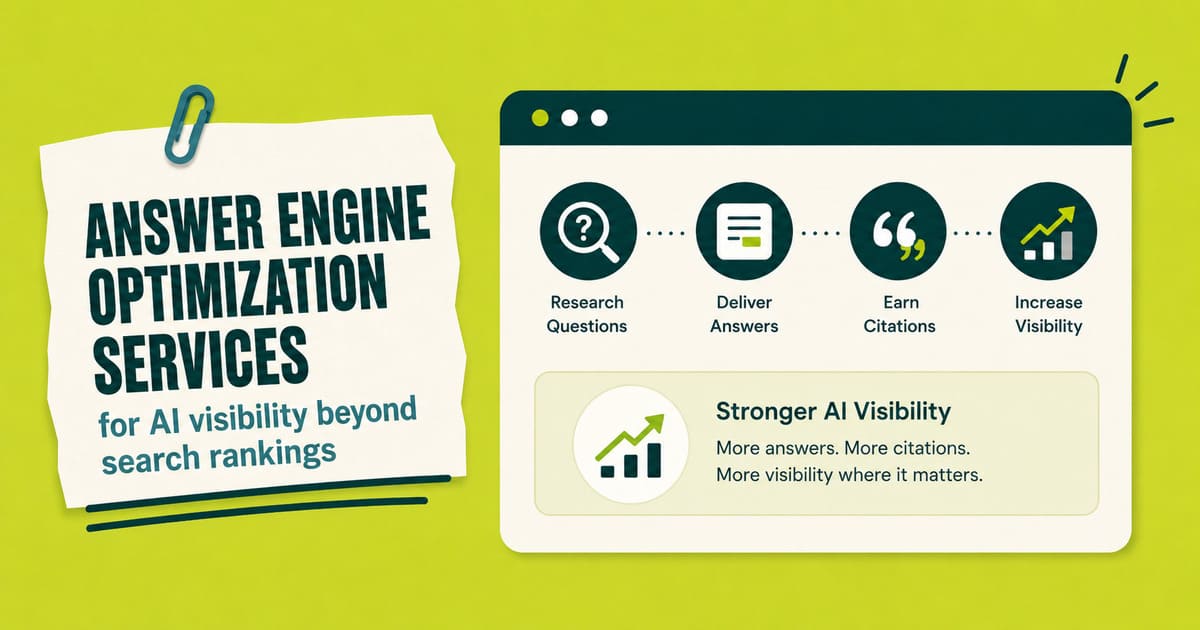
Rankings show where your pages appear in traditional search results. Separate data shows when your page appears as a source. Citation checks show which pages AI search links as sources. Answer reviews show which facts AI search uses. Analytics can show AI visits when referral data is available.
Start with what is missing: a source appearance, citation, answer use, or AI visit. Then choose the AEO service that addresses that problem. After the fix, test the same question again and compare the new AI result. You can waste budget on crawler fixes when AI search can already reach your page.
Search Rankings Show Only One Part of AI Visibility
Search rankings show where your page appears in traditional search results. AI visibility covers several events after ranking. Your page may become a source and earn a citation. Later records can show answer use and AI visits.
Google shows AI Overviews only when an AI response can add value for the query. Search eligibility alone cannot guarantee an AI Overview appearance. AI Mode and AI Overviews can also show different supporting links, according to Google Search documentation.
AI products can show different source pages for the same topic. Your ranking report cannot show what happens after ranking.
Six events show where your AI visibility stops:
A citation cannot happen when AI search never finds your page. AI search may never start for that question. Another question may trigger AI search without showing your page.
Record every important question that produces no AI search result. For questions that trigger AI search, check if your page appears as a source. When another URL earns a citation, compare the facts on both pages. After citation, compare the AI answer with your page. Mark the parts that use information from your page. Review AI visits and qualified enquiries after visibility appears.
Your page can rank well while no AI Overview appears. Another question can show AI sources without your page.
Make Important Pages Available to AI Search
AI search must reach your important pages before you can improve citations. Google Search AI features depend on normal Search eligibility. ChatGPT Search discovery uses OAI-SearchBot, while GPTBot covers potential model training access.
Your page needs index and snippet eligibility before Google can show supporting links. Googlebot crawls your pages for Google Search. Google-Extended controls some Gemini training and grounding uses outside Google Search. The Google-Extended purpose differs from Googlebot Search access.
OpenAI separates Search discovery from training access in the publisher documentation. OAI-SearchBot supports ChatGPT Search discovery. GPTBot covers potential model training access.
| Control | Main purpose | Evidence to inspect | Possible fix |
|---|---|---|---|
| Googlebot | Google Search and Search AI access | robots rules, page fetch, index status | crawl and index fixes |
| Google-Extended | some Gemini training and grounding use | Google-Extended rule | policy review where relevant |
| OAI-SearchBot | ChatGPT Search source discovery | robots rules and server logs | ChatGPT Search access changes |
| GPTBot | OpenAI training permission | robots rule | training permission decision |
| Page rendering | can crawlers read the main text | rendered HTML | JavaScript and rendering fixes |
| Canonical and internal links | correct URL and internal links | canonical and crawl map | canonical and internal link fixes |
A broad AI bot access label hides important differences. Name each crawler, platform, and purpose during your review.
Robots rules show permission. Server logs show actual crawler requests. Both records provide evidence from your own site.
A technical SEO for AI search review needs concrete evidence. Confirm index status and HTTP 200 access where required. Inspect rendered text and the canonical URL. Add at least one relevant internal link when the page lacks one.
Match Related AI Search Questions to the Right Page
One search question can expand into several related searches. Google calls the process query fan-out, where one question creates several related searches. Group related questions and map each group to the right page.
Google also warns against mass page creation for query variations. Images, video, local business data, and product data also deserve review for generative Search. For local and shopping searches, current Business Profile and Merchant Center data also deserve review. Google generative AI documentation covers these search features and data sources.
Suppose your service page targets AEO services. The same page may also need pricing, citation, ChatGPT visibility, reporting, and provider comparisons. One page works when those questions support the same decision.
citation
ChatGPT visibility
reporting
provider comparisons
Problem-focused searches may ask why AI search misses your page or citation. Closer to a decision, searches may compare methods, providers, pricing, proof, and platform coverage. Near a buying decision, your page needs exact service details, evidence, and next steps.
Visual comparisons need useful images. Product searches may need price, availability, images, and Merchant Center data. Local searches need Business Profile facts, services, categories, and reviews. Process questions may need steps or video.
Use query fan-out research to group related searches. One new page for every wording variation creates unnecessary duplication. A single core page can serve searches with the same intent. Create another page only after the search intent changes.
Question coverage and citation choice need separate reviews.
Fix Pages That Get Found but Lose the Citation
Once AI search finds your page, another source can still win the citation. Controlled tests found that closer topic matches won more citations. Current prices and recent dates also improved citation results in tested conditions.
A 2026 citation study tested 252,000 two-page comparisons across six AI models. The study supplied two source pages and changed one factor per comparison. A closer topic match produced one of the largest citation changes. Formatting-only edits produced little effect.
The experiment began only after AI search had found both source pages. Search ranking and source discovery fell outside the experiment. Researchers also hid brand and publisher names. The experiment therefore cannot show how reputation changes live citations.
Source order also changed citation results. You cannot control source order inside the AI input.
Compare your page with the cited page. Another source may contain a newer price, the exact comparison requested, or better supporting evidence. Fix the missing information before changing formatting.
Your service page may already appear during citation checks. Another source can earn the citation with the exact comparison fact requested. A new crawler audit would target the wrong issue.
Start with the exact question and compare both pages. Check missing facts, dates, prices, evidence, and comparison details. Once you confirm the citation problem, review the page changes that can help earn AI citations.
For health, finance, or legal questions, review source quality more closely. Prefer primary sources and direct evidence for these pages.
Check What Your Cited Page Adds to the AI Answer
Citation count shows visible source credit. After citation, check how much of the AI answer your page actually supports. Match answer claims with useful passages on your cited page.
A 2026 citation support study analyzed 602 prompts. The study also reviewed more than 21,000 search citations. Higher citation counts could still come with limited answer support. One cited page may support one small claim. Another cited source may support several parts of the answer.
Check definitions, numbers, comparisons, and steps. Match each item with the cited wording, date, units, and relevant details.
Review the answer against the cited page:
A manual review shows the visible link between the answer and cited page. You cannot see every source detail used inside the AI system.
After your page gets cited, focus on the facts the answer uses. Improve weak facts, definitions, numbers, and comparisons that AI can retrieve and quote.
Check Brand Facts Beyond Your Own Website
AI visibility can depend on information published outside your website. Review public profiles, Business Profile data, outside articles, and conflicting company facts.
Google generative Search can use information from many web sources. Examples include blogs, videos, forums, Business Profile, and Merchant Center. The Google generative AI documentation also recommends accurate business and product information.
Start with your own website. Your service pages and case studies should contain accurate business facts. Author and company pages need the same accuracy.
For local or ecommerce visibility, check Business Profile and Merchant Center data. Compare locations, services, categories, prices, availability, and images with your website.
Independent articles, profiles, reviews, forums, and videos need the same fact check. Public sources can match your website or show conflicting information.
Review each important fact across public sources:
Your website may list Greater Noida while an older directory lists Noida. Record the conflict before changing page copy. Update the source containing the wrong fact.
For local visibility, review Business Profile, service areas, categories, and reviews. Ecommerce pages need matching Merchant Center prices, availability, images, and product facts. B2B pages need service evidence, specialist credentials, and independent coverage.
Accurate profiles and genuine editorial coverage support your public brand facts. Manufactured praise, planted comparison pages, and fake public claims weaken trust.
Backlink count remains an SEO metric. Check which public sources show the correct brand facts. For more detail, review how AI platforms choose brands for answers and recommendations.
Control What AI Search Can Reuse From Your Page
Sometimes you need AI search to show less of your page. Google and Bing document preview controls for supported Search and AI results. Apply only the controls documented for that platform.
Google supports nosnippet, data-nosnippet, max-snippet, and noindex for Search display controls. Some of these controls also affect Google AI features.
Bing supports data-nosnippet for selected content in snippets and AI answers. You can exclude one section while leaving the wider page indexed in supported Bing results.
nosnippetdata-nosnippetmax-snippetnoindexSearch display controls. Some of these controls also affect Google AI features.
Bing
data-nosnippetSelected content in snippets and AI answers. Exclude one section while the wider page stays indexed.
These controls can help with expired offers and standard legal text. Temporary A/B test copy may also need limits. Premium sections and frequently changing reviews may need similar controls.
A short AI quote can distort text that needs surrounding context. Use a preview control only when the platform documents that exact behavior.
Test again after Google or Bing crawls the changed page. A code change alone proves nothing. Confirm the intended section disappears from the supported Search or AI result. The wider page should still appear as expected.
Measure AI Visibility Beyond Rankings
Track AI search results beside your traditional search rankings. Start with data reported directly from each platform. Use manual records for details missing from platform reports.
Start With Data From Each Platform
Google Search Console can report generative AI impressions and pages for eligible sites. The dedicated Generative AI performance report also includes countries, devices, and dates.
Bing AI Performance reports citations, cited pages, grounding queries, and citation trends. These metrics show citations and cited pages that ranking reports miss.
ChatGPT Search referral URLs can include utm_source=chatgpt.com. Your analytics system can use that value for referral tracking.
utm_source=chatgpt.comYour analytics system can use that value for referral tracking.Platform data deserves priority over a third-party visibility score.
Record Missing Data Manually
Some AI products provide little website reporting. Save the search question, platform, country or city, and date. Record the saved answer, brand mention, and cited URL too. Include the number of checks for each question.
Manual records differ from platform analytics. Your AI search analytics report should separate platform data from manual checks.
Know What Citation Data Misses
Citation tracking records visible source credit. Visible citation counts cover only credited sources. Your page may be missing from the source list before citation choice begins.
AI search may skip the web or leave your page out. Your page may also appear without visible credit. Different platforms can use different source pages for the same topic.
Record the platform, question set, country or city, date range, and data source. One combined visibility score can hide platform differences.
question set
country or city
date range
data source
Compare Your AEO Results With Overall AI Traffic Growth
Raw AI referral growth can make agency results look larger than the actual change. Compare changed pages with similar unchanged pages across the same period. Track citations, AI visits, and qualified enquiries for both page groups.
A June 2026 natural experiment offers a useful example. ChatGPT referrals grew 5.7x on the studied high-traffic domain. Pages without the content changes still grew 3.5x during the same period. After accounting for unchanged pages, the estimate fell to 1.82x. The 95% confidence interval ran from 1.31 to 2.54. A stricter placebo test produced p=0.16. Cause and effect remained uncertain.
5.7x
3.5x
1.82x
placebo p=0.16
cause and effect uncertain
If your ChatGPT traffic rises 5x, avoid crediting every extra visit to the page changes.
Choose a similar unchanged page group when enough comparable pages exist. The comparison helps separate platform growth, seasonal changes, and changes affecting your whole site.
One growth number should never become a normal AEO expectation.
Check the Evidence Behind Common AEO Tasks
Every AEO task should solve a problem you can prove exists. Pay only for an AEO task tied to a proven problem.
Google reports no Search visibility benefit from llms.txt. Generative Search also requires no special chunk size, AI writing style, or AI-only schema. Mass page creation for every fan-out query can become search manipulation. Google also warns against inauthentic mentions.
llms.txtNormal schema markup can still support visible page details and existing Search features. The concern comes from special AI schema sold as a universal requirement.
Citation rate should never become your only service target. Factual quality and reader value need equal attention.
Before approving an AEO task, ask four questions:
When AI search can already reach your page, review question coverage. Once the right page answers the right questions, review citation choice. After citations appear, check answer use, AI visits, and qualified enquiries.
question coverage
citation choice
answer use
AI visits
qualified enquiries
Choose AEO Services From the Problem You Find
Choose your AEO services after you find the first missing AI search result. Use evidence from that exact problem before choosing a service.
| Problem | AEO service | Evidence before the fix |
|---|---|---|
| target question produces no AI answer or web search | measure the question first | saved answer and dated question record |
| AI search cannot reach your important page | fix crawl or index access | index status, crawler logs, rendered page, canonical |
| related questions lack the right page | group related questions and assign the right page | question list, assigned page, missing evidence |
| your page appears but another source gets cited | compare your page with cited pages | dated citation checks and page facts |
| your cited page supports little of the answer | check what your cited page supports | answer claims and matching source passages |
| public brand facts conflict | correct conflicting public brand facts | website, profiles, reviews, outside articles |
| Business Profile or Merchant Center data is incomplete | update platform business or product data | current profile or feed |
| AI search should exclude selected page content | apply Google or Bing preview controls | page section, platform rules, before-and-after result |
| rankings exist but AI visibility remains unknown | start AI visibility tracking | starting platform data and manual checks |
| AI referrals rise but agency impact is unclear | compare changed and unchanged pages | page groups, dates, citations, visits, enquiries |
Use the table to match each problem with the right AEO service. One problem rarely needs a large service package.
Know When You Can Stop Each AEO Task
The same evidence that found the problem should show when the task is finished. Then move budget toward the next missing AI search result.
Technical access has done its job once priority pages pass crawl and index checks. Core text should render correctly. Canonical URLs and internal links should also point toward the intended page.
Question mapping ends after each important search need has a suitable page. Each page should contain the facts or media needed for that search.
Fix the missing fact or topic-match problem before repeating citation checks. Repeated citation checks can then test the revised page.
After a page gets cited, compare important answer claims with source passages. Correct missing or outdated evidence before another review.
Brand fact checks can end after important facts match across your website and public profiles. Business Profile or Merchant Center data should also match where relevant.
Preview controls need a before-and-after test in the supported Google or Bing result. Confirm the selected content appears or disappears as intended.
Your measurement is complete once the records answer the question you started with. Include platform data, manual checks, and comparison data where needed. Referral and enquiry records should use the same reporting period.
Before moving budget, confirm which problem is now fixed. Then identify the missing AI search result. The remaining problem should decide which AEO service comes next.
Noida SEO provides Answer Engine Optimization services for AI visibility problems you can prove with evidence.
Useful AEO services start with evidence. Move on after the same evidence shows the problem has been fixed.

Manish Singh is Head of Generative AI at SEO Noida and has 14+ years of experience in SEO, UX, and digital marketing. He focuses on how Google and AI platforms find, interpret, and cite web content. His articles cover AI SEO, GEO, AEO, LLM SEO, entity optimization, content architecture, and visibility measurement, drawing on website audits and campaign work.