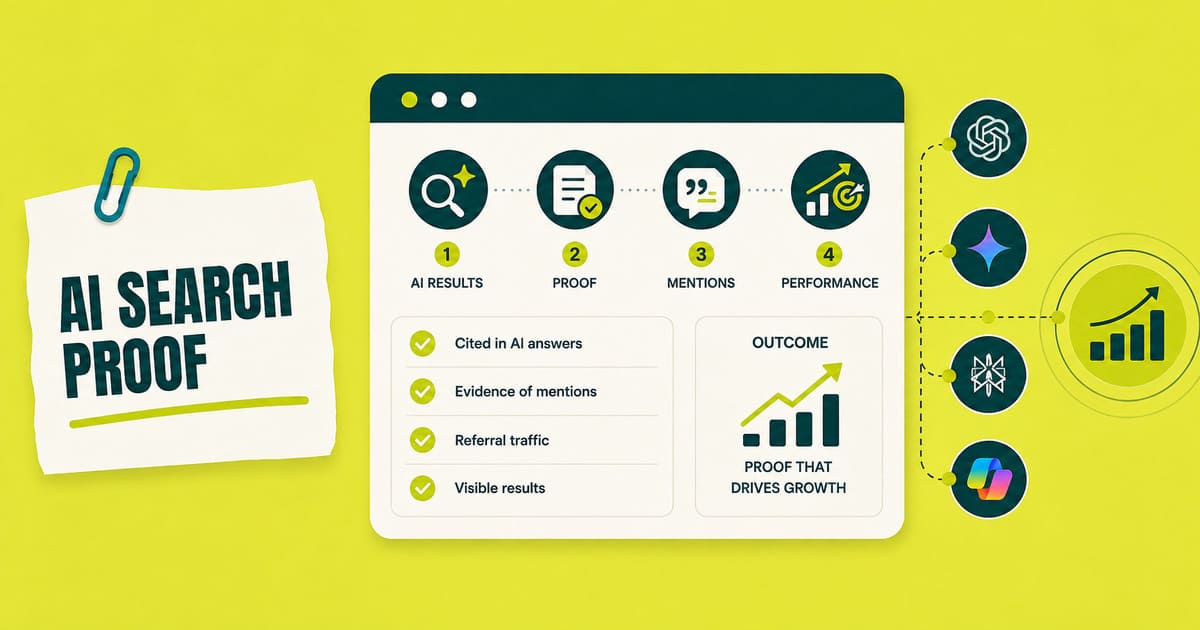
An AEO agency can show one favorable ChatGPT answer without dates, repeated tests, or source records. AI answers can change across platforms and repeated checks. One screenshot captures one output from one moment.
Useful case evidence starts with results saved before page work. Save the buyer question, platform, date, cited page, and competitor names. Later checks show which appearances remained, appeared, or disappeared. Visits and enquiries show what happened after mentions or citations appeared.
One AI Answer Does Not Prove an AEO Agency’s Results
One AI answer shows what appeared in one test. A result carries more proof when the same question produces it again later.
A 2026 ACL study compared Google organic search with five generative search systems. Researchers found differences in source use and answer stability across those systems. Results also changed across time and repeated checks.
Save these details with every important screenshot:
A cropped screenshot without those details captures one selected moment. Saving full test details makes later answers easier to compare.
Record AI Search Results Before AEO Work Starts
Save first AI search results before agency work starts. Later comparisons need original questions, platforms, dates, and raw numbers. Save referral visits and enquiries from the same period.
Google now provides generative AI performance reporting in Search Console for some websites. Available reports can include impressions, pages, countries, devices, and dates. Pair available Google data with saved answer records from each platform.
Starting data needs three groups.
AI answer data
buyer question
platform
brand appearance
cited URL
competitor appearance
number of checks per question
Website data
AI referral visits
landing pages
forms
calls
bookings
qualified enquiries where tracking exists
Test details
date
country or location
measurement tool
total questions tested
checks per question
product mode where relevant
Use an AI search visibility audit to save these records before page work starts.
Raw numbers show what large percentage changes represent. A rise from 1 citation to 6 equals 500%. Moving from 100 citations to 600 also equals 500%.
Both percentages match, while raw counts show very different volumes. Ask for starting and later counts beside every percentage.
Measure Mentions, Citations, Recommendations, Visits and Leads
Mentions, citations, recommendations, visits, and leads measure different outcomes. Report each one as its own number. One result cannot prove the next.
| Result | What happened | What needs another check |
|---|---|---|
| Mention | Brand name appears | Citation or website visit |
| Citation | AI links a page | Recommendation or visit |
| Recommendation | Brand appears as a choice | Citation or enquiry |
| AI visit | Person enters the website | Qualified enquiry |
| Lead | Person contacts the business | Sale or source connection |
Brand Mention: Your Brand Appears in the Answer
Brand mention shows that a business name appeared in the answer. Answer may contain no source link for that brand. Separate questions containing the brand name from questions without it.
A mention carries more buying relevance when someone compares providers. Report question type beside each mention count.
Citation: AI Links to a Web Page
Citation records the exact page linked from an AI answer. Cited page may belong to the client or another publisher. Record each cited URL, beyond a domain total.
Open cited pages and confirm which information supports each answer. Report citation counts apart from brand mentions.
Recommendation: AI Presents Your Brand as a Choice
Recommendation occurs when an AI answer presents a brand as a choice. Track competing brands shown in the same buyer-focused answer.
Recommendation can appear without a client-owned citation. Report recommendations and citations as separate numbers.
AI Visit: Someone Clicks Through to Your Website
Citation needs a click before website traffic appears. Pew tracked 68,879 Google searches from 900 U.S. adults. Users clicked a link inside an AI summary on 1% of visits containing one.
Track landing page and referring AI platform where analytics can identify them. AI search analytics should report appearances, citations, visits, and later enquiries apart from each other.
Lead: A Visitor Contacts Your Business
Lead tracking starts when an AI visitor contacts the business. Count forms, calls, consultations, demos, bookings, or qualified enquiries. Define a qualified enquiry before monthly reporting starts.
calls
consultations
demos
bookings
qualified enquiries
Separate direct AI enquiries from people returning through another source. A person may discover a brand through AI search, leave, then return later. Report both patterns when analytics and CRM records support them.
Revenue claims need CRM, sales, or transaction records. Use revenue numbers only when source data connects each transaction with its acquisition source.
Repeat the Same Buyer Questions
Repeat the same core buyer questions during later checks. Removing poor-performing questions can make later reports look better than the original test.
OpenAI documents that ChatGPT Search can rewrite one request into targeted searches. ChatGPT Search can also perform additional searches after reviewing earlier results. One exact question may represent only part of the search process.
Record location and major account conditions when they can affect answers. Keep these details with every later comparison.
Use four groups for buyer questions.
Noida SEO covers how AI platforms choose brands across related buyer questions.
Use the same process every reporting period:
Keep poor-performing questions in historical reports. If a question leaves the test set, record why.
Check Results on Each AI Platform
Check ChatGPT, Google AI Overviews, Gemini, and Perplexity on their own. One combined score can hide high numbers on one platform and low numbers elsewhere.
Google documents that AI Overviews and AI Mode can use different models and techniques. Responses and links can vary across Google AI experiences.
Gemini still needs its own result record. Google documents that Gemini API with Google Search grounding can create one or several searches and return cited answers when that tool is enabled.
Perplexity also uses its own web access system. Perplexity describes PerplexityBot as a crawler built to surface and link websites in search results.
| Platform | Ask to see | Save with each result |
|---|---|---|
| Google AI Overviews | query, answer, cited URL | date, market, AI Overview shown or absent |
| ChatGPT Search | buyer question, answer, source links | date, location, major account conditions |
| Gemini | buyer question, brand appearance, displayed sources | date, product context |
| Perplexity | buyer question, answer, cited sources | date, market |
Third-party tools can calculate AI visibility differently. Ask for tool name, total questions tested, checks per question, platforms, market, reporting period, and score formula.
A combined number has little value without those details.
Check the Exact Page AI Cited
Open cited URL before accepting an AI citation count. Review page content, supporting passage, owner, date, and work completed on that URL.
Follow each important citation through six points:
Inspect each cited page using these checks:
Also ask one important question: did cited page exist before agency work started?
Live citation can still point to a page that barely supports the answer. Read cited passage before treating citation as useful evidence.
If a case study reports 40 citations, inspect how many link client pages, third-party profiles, directories, or outside publishers. Then review which client pages received agency work.
See how AI citations work when reviewing linked pages and source evidence.
Compare Your Brand and Competitors on the Same Questions
A brand can improve while its main competitor improves more. Compare both brands with the same questions, platforms, market, dates, and calculation.
Use four numbers for every competitor:
Keep competitor list stable unless market conditions materially change. Record any competitor addition or removal inside reporting notes.
Avoid a custom combined score when raw numbers tell the reader more.
If client visibility moves from 10% to 20%, while a main competitor moves from 25% to 55%, client numbers improve but competitor distance grows. Both numbers are needed before crediting agency work with competitive improvement.
Use the same calculation for every brand. Changing question sets, dates, or competitor lists can distort comparison.
Check What the Agency Changed Before Results Improved
Match later AI results with dated agency work. Identify page, source, or technical changes made before each reported result appeared.
Useful AEO case study needs more than before-and-after percentages. Record what agency changed and when each change happened. Compare later AI answers with those dated changes.
One client record might save starting questions in week 0, log page edits in week 2, record a technical fix in week 3, then note a new citation in week 5. If referral visits rise later, save that date too.
Those dates show reporting format, never a standard timeline.
Four proof levels can help review the connection:
Each additional match supports a stronger connection with agency work. No single match proves cause on its own.
Where possible, compare changed pages with similar unchanged pages during the same period. Also review platform updates, competitor changes, category growth, and seasonal changes before crediting agency work.
Check Case Study Claims Outside the Agency Website
Confirm important case-study claims outside the agency website. Review client identity, cited pages, dates, public references, and raw numbers.
Client relationship checks
Result checks
Reviews support client experience. AI search records support reported results.
Apply the same checks to Noida SEO case studies.
Question Any Promise of Guaranteed AI Rankings
An AEO agency controls its work, testing, and reporting. AI platforms control answer wording, citation choice, and brand inclusion.
Google states third-party SEO tools lack access to internal Google ranking data. Its advice also covers AEO and GEO claims tied to performance guarantees.
Contracts can include firm work commitments.
Agency can commit to:
agreed buyer questions
agreed platforms
starting records
approved page work
citation checks
reporting dates
dated work completed
AI platforms control:
model updates
answer wording
exact citation choices
competitor inclusion
product changes
placement inside generated answers
A promise to track 100 agreed buyer questions each month is measurable. A promise of guaranteed position 1 in ChatGPT depends on an outside platform.
Use the same control test when choosing an AI SEO agency.
Ask for Proof of One Client Result From Start to Finish
Ask for one full client record from starting results through visits and qualified enquiries. One complete record carries more proof than many selected screenshots.
1. Starting Results
Request original buyer questions and platform records. Add citations, competitor appearances, AI visits, and reporting dates.
Starting record should exist before major agency work.
2. Work Completed
Request dated page changes and technical work. Record outside coverage or publisher work connected with target questions. Separate planned work from changes that reached the live website.
3. AI Search Change
Request exact answers for the same buyer questions. Record new citations, lost citations, brand appearances, and recommendations.
Add exact cited URLs beside each important result. Repeat later checks under the same test conditions.
4. Competitor Change
Compare client with the same competitors and questions. Use the same reporting period and calculation for every brand.
5. Business Response
Request AI referral visits and landing pages. Add qualified forms, calls, demos, or consultation bookings.
Separate direct AI enquiries from enquiries after a later return visit. Some AI visits will never produce a business enquiry. Some visitors may return through another source before contacting the business.
Report those limits beside business numbers.
Complete AEO case study connects all five records. If a record is missing, narrow the claim. Never fill missing data.
What an AEO Results Report Should Show
Useful AEO report should show test details and raw results. It should also show cited pages, competitors, AI visits, and enquiries.
Ask for four reporting groups.
Test record
reporting period
buyer question set
platforms
country or location
measurement source
checks per question
AI result record
brand appearances
citations
recommendations
exact cited URLs
lost results
new results
platform for each result
Competitor record
main competitor appearances
client versus competitor change
questions where leadership changed
competitor additions or removals
Business record
AI referral visits
landing pages
qualified enquiries where available
calls or bookings where tracked
later-return enquiries where data supports them
Before accepting a report, ask three questions:
Noida SEO offers an AI search audit for a second review before signing a larger AEO contract.
Reviews support client experience. AI search records support reported results.

Manish Singh is Head of Generative AI at SEO Noida and has 14+ years of experience in SEO, UX, and digital marketing. He focuses on how Google and AI platforms find, interpret, and cite web content. His articles cover AI SEO, GEO, AEO, LLM SEO, entity optimization, content architecture, and visibility measurement, drawing on website audits and campaign work.