Pew Research found lower click rates when AI summaries appeared. Users clicked traditional results in 8% of visits with AI summaries. Without AI summaries, users clicked traditional results in 15% of visits.
Start with Search access. Then check AI crawlers, entity signals, schema, prompts, citations, and competitor pages.
Quick Answer
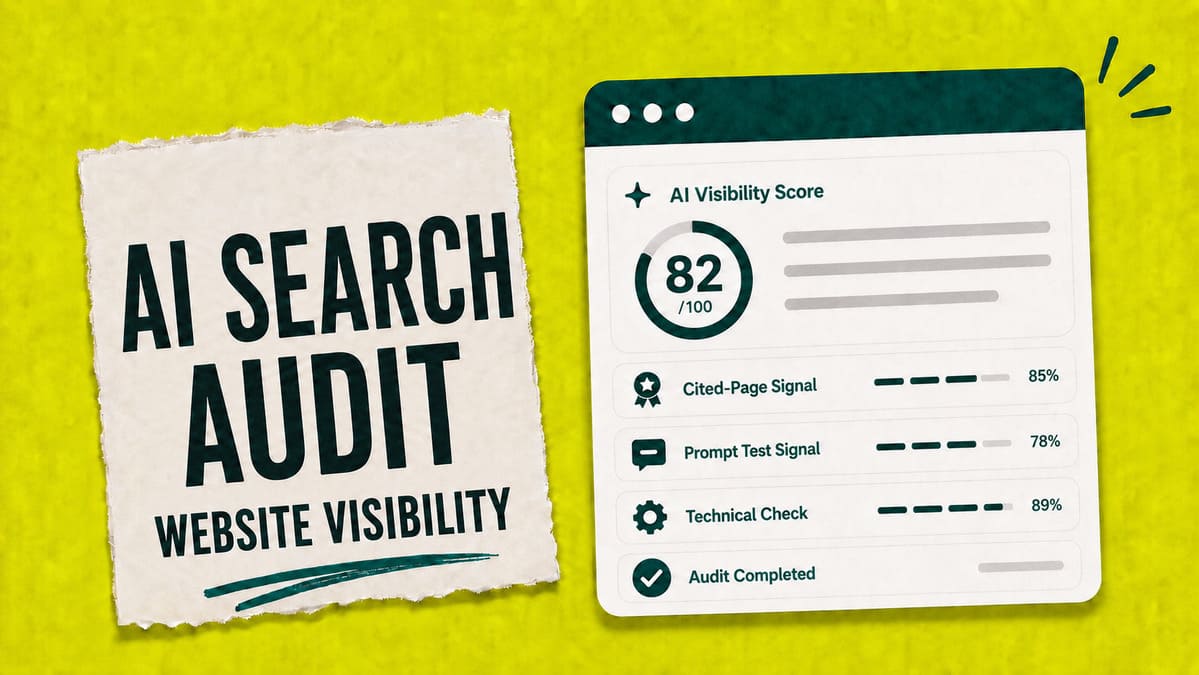
An AI search visibility audit checks if AI engines find your site. It checks if those engines trust and cite your pages. The review covers Search access, AI crawlers, entity signals, schema, answer blocks, prompts, mentions, citations, and competitor pages. You leave with a score and fix list.
AI Search Visibility Audit Checklist
Audit steps work best when the order protects the basics. Prompt tests have low value before indexing and crawler access.
- Search access
- AI crawler access
- Entity signals
- Answer-first content
- Schema quality
- Prompt visibility
- AI mentions
- AI citations
- Competitor citation gap
- Fix order
Each item marks one visibility blocker. The score shows where the first fix belongs.
AI Visibility Audit vs SEO Audit
An SEO audit checks if a page can rank. An AI visibility audit checks brand presence inside AI answers.
| Audit Area | SEO Audit | AI Visibility Audit |
|---|---|---|
| Crawlability | Yes | Yes |
| Indexing | Yes | Yes |
| Rankings | Main metric | Supporting signal |
| Snippets | Yes | Yes |
| Entity signals | Sometimes | Core layer |
| Schema markup | Sometimes | Core layer |
| Prompt visibility | Rare | Required |
| AI mentions | Rare | Required |
| AI citations | Rare | Required |
| Competitor pages | Rare | Required |
A ranking report shows where a page appears in Search. An AI audit shows buyer-prompt presence across AI engines. Pages can rank for SEO audit checklist yet miss AI answers.
Search eligibility has two basic parts here. Google must index the page. Google must also show a normal snippet for the page. Google lists those points for AI Overview and AI Mode supporting links, with no extra technical requirement.
For related reading, use the Knowledgebase entry on people-first content. It covers reader-first pages, evidence, useful depth, and limits.
Step 1: Make Sure the Page Can Appear in Search
Start with Google Search access before any AI test. If Google cannot index the page, fix access first. Google AI feature docs point back to standard Search eligibility.
Google Search Console URL Inspection
Open URL Inspection in Google Search Console for the live page. Enter the exact URL buyers need to find. Review index status, chosen canonical, last crawl, and warnings. A canonical tag tells Google which page version counts. When Search Console shows discovered but not indexed, access failed.
Fix access before copy, schema, or FAQ changes. A service page can look polished and still fail. Google can choose another canonical URL as the source. Fresh edits miss Search until Google crawls the page.
Noindex, Robots.txt, and Canonical Blocks
One technical rule can remove a useful buyer page.
| Blocker | What It Does | Audit Step |
| noindex | Removes a page from Google index | Remove from public buyer pages |
| robots.txt block | Blocks crawler access | Review disallow rules |
| wrong canonical | Points value toward another URL | Correct the canonical tag |
| staging block | Hides a live page | Remove launch leftovers |
Google supports noindex, nosnippet, data-nosnippet, and max-snippet controls. Google also lists snippet controls for Search display and AI features.
Snippet Eligibility
Snippet eligibility affects Google AI feature support. If a page blocks snippets, Google has less display text. A snippet is the preview text under a Google result. Google requires snippet eligibility for AI Overview or AI Mode links.
Pages with nosnippet on the main answer hide useful text. Service pages with answers inside images lose text value. Pass when Google indexes the URL. Pass when Google chooses the right canonical. Pass when Google forms a normal snippet.
Step 2: Let AI Search Crawlers Reach the Site
Google Search access covers only one visibility layer. ChatGPT Search uses separate crawler rules from OpenAI. OAI-SearchBot needs its own audit check.
OAI-SearchBot
OAI-SearchBot supports website discovery in ChatGPT Search features. OpenAI documents OAI-SearchBot separately from GPTBot. GPTBot has a different job: model training access control.
| Crawler | Audit Use |
| OAI-SearchBot | ChatGPT Search visibility access |
| GPTBot | model training access control |
| ChatGPT-User | user-request visits from ChatGPT |
Audit OAI-SearchBot apart from GPTBot access. A site can allow one crawler and block another. Crawler access helps discovery but promises no citation.
For a deeper crawler check, use the Knowledgebase entry on AI crawlers. It covers crawler types, robots.txt rules, official crawler names, and server logs.
Robots.txt and Server Blocks
Robots.txt can allow a crawler while server tools block it. Your CDN, firewall, host rule, or bot filter can reject requests. Check the request before the page content loads.
Check these items:
- robots.txt user-agent rules
- CDN bot filters
- hosting firewall logs
- security plugin blocks
- server status codes
- official IP records
Robots.txt can allow OAI-SearchBot. A firewall can still block the request. Server logs prove access better than a visual robots.txt scan.
Step 3: Make the Business Entity Clear
AI engines need stable business details before describing a brand. Entity signals help AI know who you are. Those signals connect your name, service, place, author, profiles, and schema.
Brand, Service, and Location Consistency
Use one business name across the website and profiles. Use the same service labels across pages and posts. Match city terms such as Noida, NCR, and Delhi NCR.
Audit these fields:
- brand name
- service names
- city and region wording
- phone number
- business address
- Google Business Profile
- directory profiles
- author name
Local mismatches weaken how AI identifies the business. One page uses one brand label. Another page uses a different label. A directory profile uses a third label. Those mixed names create avoidable entity risk.
For a plain entity reference, use the Knowledgebase entry on entity SEO. It covers named things, schema, trust signals, and local checks.
About Page and Author Signals
Your About page and author bio create a trust anchor. The page should name the author, business, and claim owner.
Add visible proof:
- author name
- author role
- SEO experience
- business name
- contact page
- service area
- approved case proof
A blog post about AI SEO should show the author role. The post should connect the author with the business and service area. Never invent author experience for a stronger trust signal.
Organization and Service Schema
Schema markup labels facts already on the page. Use Organization schema for the business. Use Service schema for visible service content. Use Person schema for the author.
Google notes that schema markup helps Google interpret page content. Google also warns against markup for content hidden from readers.
Schema supports page text but cannot replace it. The page should show business name, service, place, author, and contact details.
Step 4: Make Key Pages Answer the Query First
AI engines need answer-ready text before broad marketing copy. A buyer question needs the answer near the top. Deeper detail can follow after the answer.
Answer-First Content
A useful answer block follows a tight formula:
- Question asked
- Direct answer
- Entity named
- Proof added when needed
- Detail follows
Example:
AI search visibility tracks AI mentions and citations for buyer questions. It shows if AI tools recommend your business as a source.
The answer names the topic, output, and buyer context. A weak version only names the topic. A stronger version answers what the buyer asked.
| Weak answer | Better answer |
| AI visibility is important for businesses. | AI search visibility shows if AI tools mention or cite your business. |
One Question Per Section
One section should answer one buyer question. Mixed sections weaken extraction and confuse readers.
Wrong pattern: one H2 covers AI crawlers, schema, prompts, and citations. The reader faces four jobs inside one section. AI engines also lack one clean answer to lift.
Better pattern: one H2 covers AI crawler access. Another H2 covers schema markup and prompt tests. Each section opens with the answer.
Check Proof Before You Publish
Proof helps readers trust an audit. Platform claims need official source material. Client results need first-party labels and context. Competitor observations need the prompt, date, engine, and cited URL.
Use these rules:
- source every statistic
- cite official docs for platform behavior
- label brand-owned data as first-party
- remove claims with no proof
- separate opinion from evidence
This keeps the article useful for readers and safer for AI citation.
Step 5: Add Schema That Matches the Page
Schema markup should describe the page, not decorate it. Google can use schema markup to interpret content. Google gives no guarantee of enhanced result display.
Page-Level Schema
Map the page before adding markup.
| Page Element | Schema Type |
| blog post | Article |
| business | Organization |
| author | Person |
| site hierarchy | BreadcrumbList |
| visible audit service | Service |
Use Service schema only with visible service content. Use Person schema only when the author bio appears. Use Organization schema only for visible business facts.
FAQ Page and HowTo Schema
FAQPage schema belongs on visible FAQ content. HowTo schema works when the page shows steps. The 10-step audit can qualify only with visible instructions.
FAQPage belongs on the final FAQ block. HowTo belongs where steps show what to inspect. Weak audit talk does not support HowTo markup.
Schema Errors
Remove markup that overstates the page.
Remove:
- fake review markup
- hidden FAQ markup
- unsupported ratings
- wrong service markup
- sameAs links to unofficial profiles
- schema for absent case studies
- claims absent from page text
Google’s schema rules warn against hidden, irrelevant, or misleading markup. Avoid review markup unless the page shows reviews. Avoid Service schema for an offer absent from the page. Schema should support visible content, not replace it.
Step 6: Test the Questions Buyers Ask AI
Prompt visibility testing shows AI mentions, citations, and missing brands. It also shows wrong services, weak local context, and competitors.
Create one fixed prompt sheet for repeat testing. Test Google AI Overviews and Google AI Mode together. Then test ChatGPT Search, Perplexity, and Gemini.
Buyer Prompts
Start with the question a buyer would ask. Use problem, service, budget, and trust prompts. Those prompts show where AI connects need with your business.
Use clusters:
- problem prompts
- service prompts
- budget prompts
- trust prompts
Examples:
- Why is my clinic missing local leads?
- Best SEO services for clinics in Noida
- How do I choose a reliable SEO agency?
Each prompt reveals a different weakness. Problem prompts test pain match. Service prompts test category presence. Trust prompts test proof and reputation.
Brand Prompts
Ask AI what the business does. Compare the answer with the website.
Examples:
- What does this business do?
- Does this business provide AI SEO audits?
- Which areas does this business serve?
Mark missing services, wrong places, and outdated claims. A partial answer creates risk. Stronger service pages and schema can support better brand descriptions.
Comparison Prompts
Shortlist prompts show which brands enter buyer research. Record first mention, cited URL, proof source, and missing brand signals.
Examples:
- Best AI SEO agency for Noida businesses
- SEO agency vs in-house SEO for small business
- SEO company for clinics in Noida
Record which brands appear first. Note which URL AI cites. A comparison prompt tests shortlist presence, not keyword position.
Local SEO Prompts
Local prompts connect sector, service, and place. Test Noida, NCR, and sector phrases. Avoid testing only near me prompts.
| Prompt Type | Example |
| Sector plus city | SEO company for dental clinic in Noida |
| Service plus city | AI SEO audit agency in Noida |
| Problem plus city | clinic missing local leads in Noida |
| Trust plus city | reliable SEO agency in NCR |
Add sectors such as clinic, dental, real estate, education, home service, B2B, and ecommerce. Local AI visibility improves when business, service, and place entities connect.
Step 7: Track AI Mentions and Citations
Prompt results need a record your team can read. Capture the AI answer, source, accuracy issue, and next fix.
Perplexity describes its answers as source-backed. Its help page notes numbered citations linking to original sources. Track cited sources when testing Perplexity visibility.
Mention and Citation Log
Avoid a flat yes-or-no sheet. Record the answer, source, accuracy issue, and next fix.
Use one audit card for each important prompt:
| Field | What to Record |
| Prompt | Exact buyer question tested |
| Engine | Google AI Overviews, ChatGPT Search, Perplexity, or Gemini |
| Date | Test date |
| Brand result | Mentioned, missing, wrong, or partial |
| Citation result | Your site cited, competitor cited, no citation, or source unclear |
| Cited source | Exact URL or source name |
| Accuracy note | Correct, partial, outdated, wrong service, or wrong location |
| Next fix | Access, entity, schema, answer block, proof, or competitor page |
Example entry:
| Field | Example Entry |
| Prompt | SEO agency for clinics in Noida |
| Engine | Perplexity |
| Date | 30 June 2026 |
| Brand result | Missing |
| Citation result | Competitor cited |
| Cited source | Competitor blog URL |
| Accuracy note | Brand absent from shortlist |
| Next fix | Add clinic SEO answer block and proof |
The card helps your team read one prompt quickly. The next-fix field points directly toward competitor review.
Accuracy Notes
Give each AI answer one status label.
- accurate
- partial
- wrong
- outdated
- missing source
- wrong location
- wrong service
A partial answer still costs trust. If AI lists only one service, mark partial. If AI lists an old address, mark wrong location. Use official pages and schema to support better source signals.
Step 8: Find the Competitor Citation Gap
A competitor citation gap means AI picked their page over yours. Study cited pages for proof, answer format, entity signals, schema, and update dates. Use those notes to improve your page without copying competitors.
Cited Competitor Pages
Start with the cited URL and inspect the page.
| Field | What to Record |
| cited URL | exact page AI used |
| page type | blog, service page, directory, case study |
| answer format | definition, list, table, FAQ |
| proof used | statistic, author, case, source |
| schema present | Article, FAQPage, HowTo, Service |
| date or update note | visible date or update note |
| likely trust reason | why AI chose it |
Competitor pages get cited for specific reasons. Some have concise definitions. Others have visible authors, FAQ schema, or newer proof. Name the actual advantage before changing your page.
Gap on Your Page
Turn competitor review into one fix note.
Gap types:
- answer miss
- proof miss
- entity miss
- schema miss
- update miss
- local context miss
- FAQ miss
Example: a competitor has a cited FAQ answer. Your page hides the answer in paragraph five. The fix is answer-first FAQ content.
Another example: a competitor service page has visible author proof. Your page has no author signal. The fix is trust proof, not more keywords.
Step 9: Score the AI Visibility Blocks
Scoring stops random fixes and report-only numbers. Score the blocks that limit AI visibility. Use the same sheet each month for comparison.
AI Visibility Scorecard
| Area | Score |
| Search access | /15 |
| AI crawler access | /10 |
| Entity signals | /15 |
| Answer-first content | /15 |
| Schema quality | /10 |
| Prompt visibility | /15 |
| Mentions and citations | /10 |
| Competitor citation gap | /10 |
80 to 100: strong base, improve proof and citations. 60 to 79: improve entity signals, schema, and answer-first content. 40 to 59: fix access and content extraction first. Below 40: technical and entity issues block visibility.
Example: a site scores well on schema but fails AI crawler access. Fix crawler blocks before adding more FAQ content.
Treat the scorecard as an internal audit framework. It is not a universal industry benchmark. The score should drive the next fix.
Step 10: Fix the Highest-Impact Blocks First
An AI visibility audit should end with fix order. Work from access to entity signals. Then fix schema, answer-first content, proof, and tracking.
Fix Order
- Indexing and crawl blocks
- AI crawler blocks
- Entity mismatch
- Missing schema markup
- Weak answer-first content
- Unsupported claims
- Missing FAQ or HowTo structure
- Competitor citation gaps
- No tracking process
If the page has noindex, fix index access before content. If OAI-SearchBot receives a block, resolve crawler access first. If schema describes absent content, remove or rewrite it.
Avoid Hacks
Shortcuts create visibility risk.
Avoid:
- fake reviews
- mass AI pages
- unsupported statistics
- hidden schema claims
- guaranteed AI citation claims
- fake case studies
Fake proof damages trust and invites review. Google warns against irrelevant schema and hidden information. White-hat AI SEO starts with access, identity, proof, and tracking. Proof-first auditing leaves fewer risky shortcuts to undo.
When to Ask for Help With the Audit
A team can handle this audit when the site has many pages, many locations, or unclear crawler rules. Help also makes sense when AI answers cite competitors for important prompts.
Before asking for help, collect three things:
- the page you want reviewed
- the prompts you want tested
- the AI engines you want checked
The review should show where visibility breaks. It should also return a fix list, source notes, and a prompt log.
No agency guarantees rankings, traffic, or AI citations. An audit shows blockers and fix order.
FAQs
What is an AI search visibility audit?
AI search visibility audit checks how AI engines find your website. It also checks how AI engines mention and cite your pages.
The audit covers four main layers:
- access
- entity signals
- answer-first content
- citations
The audit finds missing mentions, wrong descriptions, absent source links, and competitor citation gaps.
How is AI visibility different from SEO visibility?
SEO visibility shows how pages appear in search results. AI visibility shows how answers mention, cite, or describe your brand.
Example: a ranking report shows keyword position. An AI visibility audit checks buyer visibility inside AI answers.
What is prompt visibility testing?
Prompt visibility testing uses fixed buyer questions across AI engines. The test records brand presence, cited URLs, competitors, and accuracy issues.
Use three steps:
- Choose buyer prompts.
- Test AI engines.
- Record mentions and citations.
One test cannot show a pattern. Repeat the same prompt sheet over time.
What is entity SEO?
Entity SEO helps AI identify your business. It connects your name, services, address, author, profiles, and schema.
For a Noida business, the same name should appear everywhere. Service terms should also match the website and Google Business Profile.
Does schema help AI search visibility?
Schema markup helps Google interpret page content. Enhanced Google display has no guarantee, even with correct markup.
Use Article, Organization, Person, FAQPage, HowTo, and Service schema only where page content supports them.
Can an agency guarantee AI citations?
No agency guarantees AI citations, rankings, or traffic. AI engines, Google systems, competitors, and page quality affect visibility.
An audit still has value. It finds access blocks, entity issues, weak content, missing proof, absent citations, and competitor advantages.
Related Knowledgebase Reading
Use these Knowledgebase entries for deeper checks:
- AI crawler rules, crawler names, robots.txt, and logs.
- People-first content checks, evidence, and publishing limits.
- Entity SEO signals, schema, local checks, and trust signals.
What to Do Next
Start with your highest-value buyer page. Check index status for that page. Then inspect crawler access, entity signals, schema, answer-first content, prompts, citations, and competitor pages.
Put the score in one sheet. Fix the largest blocker from the score. Test the same prompts after each update.
SEO outcomes depend on competition, site health, and ongoing work. No agency guarantees a ranking, traffic number, or AI citation.

Manish Singh is Head of Generative AI at SEO Noida and has 14+ years of experience in SEO, UX, and digital marketing. He focuses on how Google and AI platforms find, interpret, and cite web content. His articles cover AI SEO, GEO, AEO, LLM SEO, entity optimization, content architecture, and visibility measurement, drawing on website audits and campaign work.