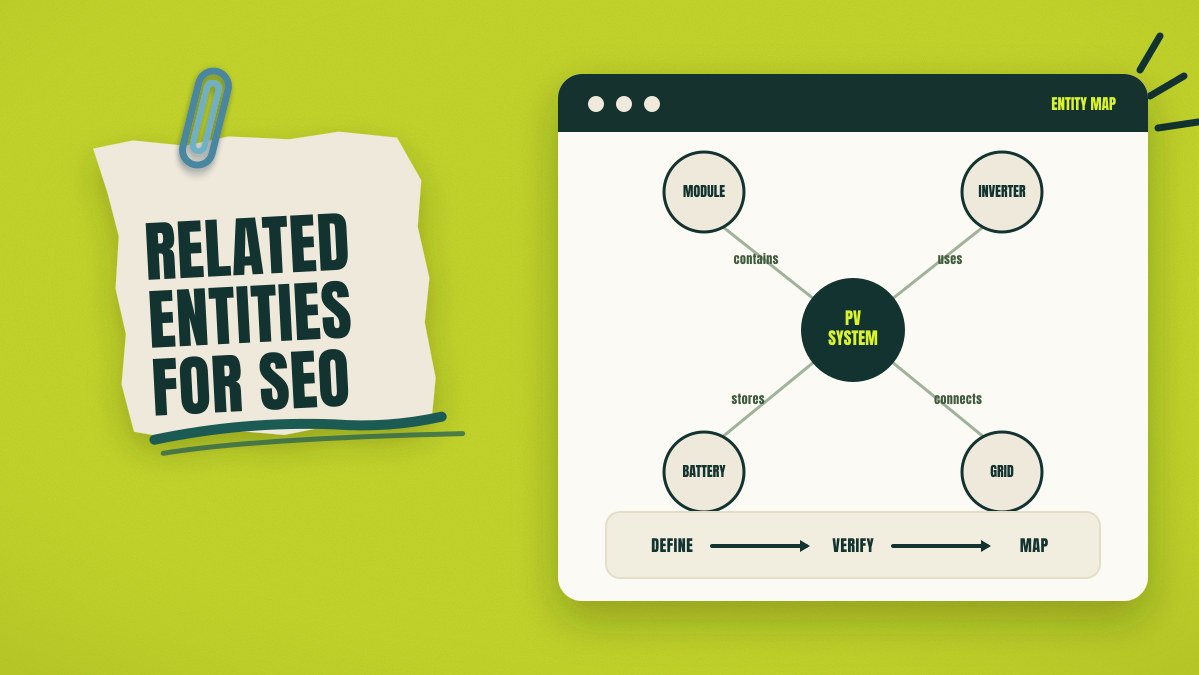
Finding related entities for SEO starts with one exact page subject. Collect candidates from trusted sources, Google results, entity databases, and website evidence. Approve each candidate after checking identity, connection, source quality, reader value, and page role. Related nouns alone cannot show how a subject works.
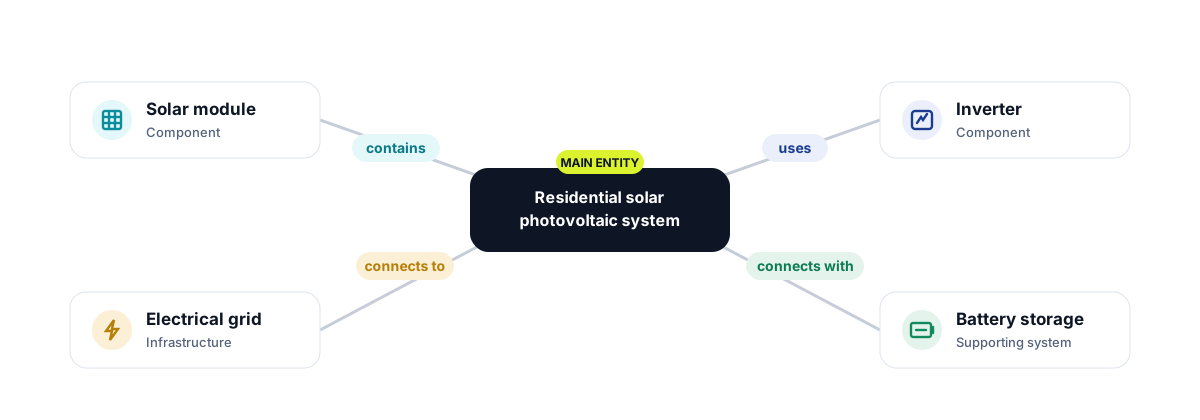
A weak list might contain solar panel, battery, inverter, and grid.
A verified map instead connects those items through factual relationships:
Google introduced the Knowledge Graph to organize information around physical, digital, and conceptual entities.
During 2012, Google reported over 500 million objects and 3.5 billion facts and relationships.
A 2020 update reported over 5 billion entities and 500 billion facts, though both disclosures remain dated snapshots without a current 2026 total.
A useful entity map links every approved item with evidence and placement. The map also records reader questions, internal links, schema roles, and review status.
What Are Entities in SEO?
An entity is a distinct thing or concept with a stable identity. A related entity connects with the main entity through one factual relationship. Attributes describe entities, while relationships connect separate entities.
Entity
A solar inverter is a component inside a photovoltaic system. A photovoltaic system converts sunlight into electricity through connected equipment. The Department of Energy identifies inverters as current-conversion components.
Related entity
A solar module becomes related through the relationship system contains module. Battery storage becomes related through system connects with storage. The connection shows why readers need each supporting entity.
Attribute
South-facing describes one possible orientation value for a roof. Roof orientation affects system suitability and expected energy production. The value belongs under the roof entity.
Relationship
A relationship uses one subject, one connection, and one object. Useful examples include contains, uses, connects to, requires, regulates, and creates.
Google Cloud entity analysis can return names, types, mentions, metadata, and salience. Salience describes how central an entity appears within submitted text, and it cannot measure rankings, authority, or citation probability.
Wikidata represents knowledge through items and connected statements, where each statement links a subject, property, and object. During July 2026, Wikidata reported about 122.5 million items and roughly 41,000 active users, and those totals change continuously.
For a wider view of why these connections build trust, see our explainer on what entity SEO is and how it builds authority.
Define the Main Entity Before Research
The main entity receives primary attention across the page. Name that subject before collecting related candidates.
A weak subject such as solar can identify energy, panels, companies, farms, or financing. Such breadth creates mixed relationships and weak page focus. A precise subject reduces ambiguity before research begins.
A stronger main entity is residential solar photovoltaic system.
Use five questions before approving the main entity:
- What exact thing does the page describe?
- Which entity type matches that subject?
- Could the name identify several different things?
- Does another page already own the subject?
- Which reader task does the page support?
For the working example, the entity type is System. The reader wants components, installation needs, grid connection, and storage options.
Schema.org mainEntity identifies the primary entity described through a page. The property confirms visible page focus through schema markup, but it cannot replace an accurate page subject or useful content.
Separate Entities From Other Candidate Types
Accurate classification prevents mixed lists and weak content plans. Sort every candidate before opening identity tools. Each candidate belongs within one primary group.
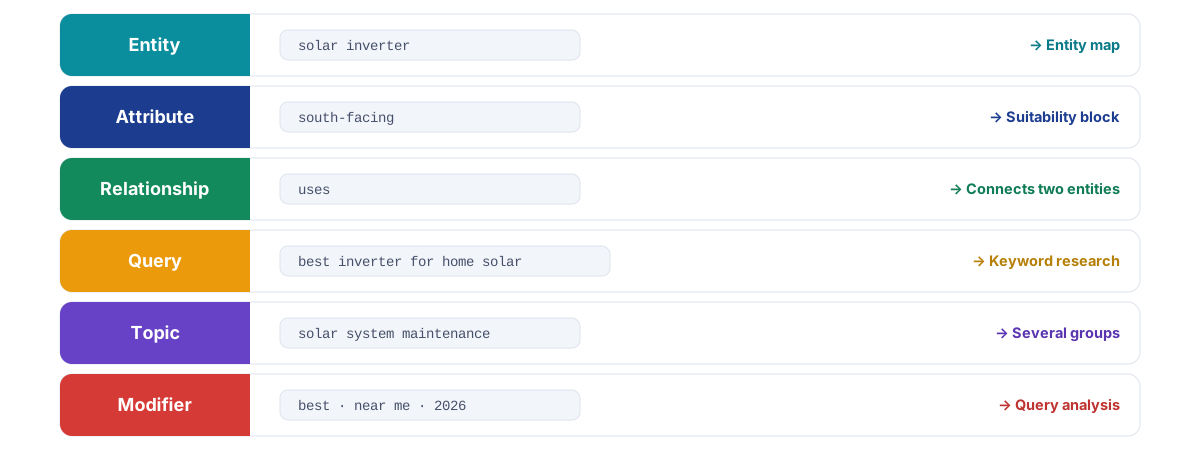
Entity: solar inverter
A solar inverter has a distinct component identity. The photovoltaic system uses the inverter for electrical current conversion.
Attribute: south-facing
South-facing describes one possible orientation value for a roof. The value lacks an independent role equal to an inverter. Place it under roof suitability or orientation criteria.
Relationship: uses
The verb connects the photovoltaic system with the inverter. Relationship wording shows why both entities appear together.
Query: best inverter for home solar
The complete phrase reflects a product comparison search. Inverter identifies an entity, while best adds a comparison modifier. The complete query belongs within keyword and intent research. Never place the complete query inside the entity map.
Topic: solar system maintenance
The topic covers several entities, processes, and attributes. Possible entities include inverter, module, battery, technician, inspection, and warranty. Topic research can produce several relationship groups.
Modifier: best, affordable, near me, 2026
Modifiers change comparison, price, location, or time scope. They support query analysis without becoming related entities.
Complete one classification check before opening identity tools. Review identity, type, attributes, and relationships first. Candidates lacking identity may remain attributes, queries, topics, or modifiers. Move each candidate into the correct research stream.
Build Relationship Categories Around Reader Needs
Entity-based SEO uses factual relationships around one main subject. Reader questions should determine those relationships before candidate collection.
A homeowner assessing residential solar needs several answers. The page should cover system parts, power conversion, and storage. It should also cover roof suitability, permits, inspections, and grid connection. Each need suggests a relationship category before research begins.
Use the following reader-task map:
Product or system relationships
Useful connections include contains, uses, connects to, compatible with, controlled through, and influenced through. Select only relationships matching visible products or systems.
Service relationships
A provider offers a service to a defined audience. A service can solve a customer problem or use a specific method. A regulator can oversee the service within defined markets. A metric can measure the service outcome.
Person relationships
Person entities may connect through created, founded, or works for. Other relationships include studied at, member of, and expert in. Use professional evidence before describing any person as an expert.
Organization relationships
An organization can own a product, employ a person, or operate within a place. A regulator can oversee an organization within defined markets. An organization can also belong to an association.
Write relationship categories before opening search tools. Those categories control candidate relevance throughout later research.
Find Related Entities From Authority Sources First
Authority sources provide precise names, processes, attributes, and factual relationships. Start with government, regulatory, research, standards, and manufacturer documentation. Competitor frequency should receive less weight than authority evidence.
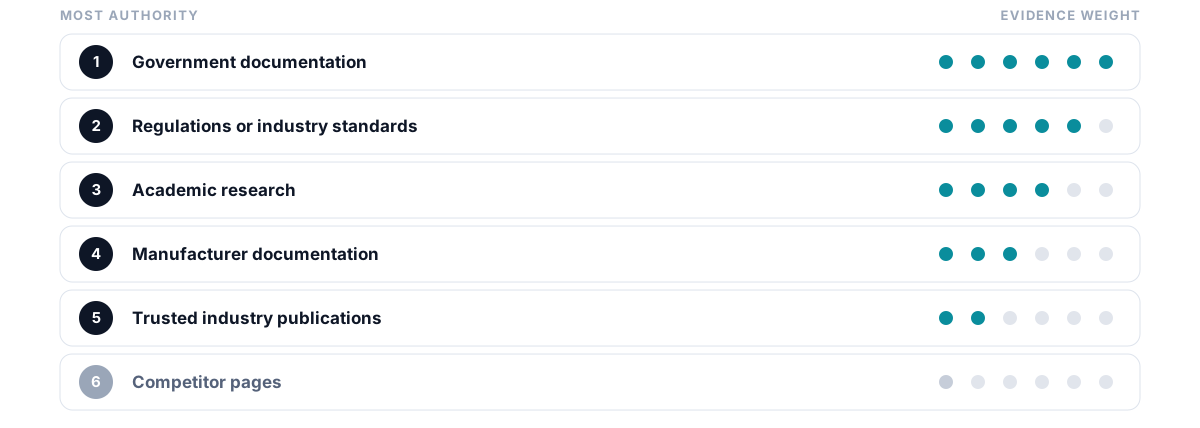
Use the following source order:
- Government documentation
- Regulations or industry standards
- Academic research
- Manufacturer documentation
- Trusted industry publications
- Competitor pages
Primary sources use exact component names and technical relationships. They also define processes, requirements, specifications, and limits. That evidence reduces vague wording and unsupported associations.
Record each candidate within one review card:
The Department of Energy provides a useful solar example. Solar modules generate electricity within a complete photovoltaic system. Inverters convert direct current into household alternating current. Batteries store generated electricity for later use. Local governments require permits and safety inspections before grid operation.
Approved relationships now include:
- Residential solar photovoltaic system contains solar modules.
- Residential solar photovoltaic system uses an inverter.
- Residential solar photovoltaic system connects with battery storage.
- Rooftop solar installation requires a permit.
- Installed solar array undergoes inspection.
Capture only relationships serving the reader task. Avoid copying every technical noun from each source. One strong relationship can provide more value than repeated mentions.
The same process shows how to find entities for SEO optimization without unrelated terms.
Find Candidate Entities From Google Results
Google results reveal candidate entities, questions, organizations, products, and processes. Another source should confirm identity and relationship before approval.
Knowledge Panel
Search the full main-entity name with its relevant location. Capture the panel title, description, type, official website, people, organizations, products, and places. Use the panel to check name, type, and official website. Avoid assuming universal Knowledge Graph coverage from panel appearance.
People Also Ask
Capture reader questions, processes, attributes, comparisons, and missing page sections. A question may contain one or several entities. The complete question remains query evidence, separate from entity identity. Classify every named candidate through the approved groups.
Ranking pages
Open 5–10 current ranking pages for relationship review. Capture named entities, relationship sentences, authority citations, process steps, and section headings. Focus on factual connections while avoiding repeated noun counts.
Record each candidate through one review card:
Google result features support early candidate and question discovery. They cannot confirm every identity, type, or page priority. Verify candidates through authority documentation, Wikidata, Knowledge Graph Search, standards, or product documentation.
Confirm Entity Identity and Relationships
Entity SEO validation requires identity confirmation and relationship evidence. Google Knowledge Graph Search and Wikidata support different parts of that check.
Confirm Names Through Google Knowledge Graph Search
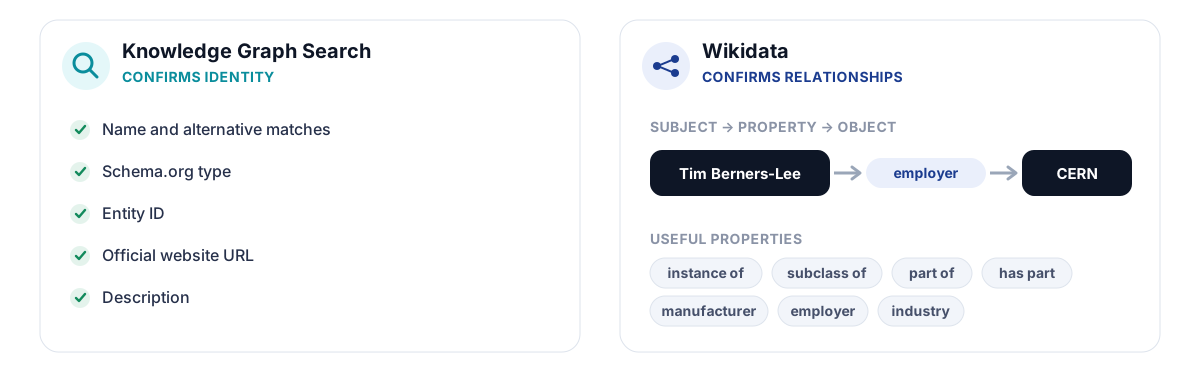
Google Knowledge Graph Search can confirm names, types, descriptions, official URLs, and entity IDs. An entity ID is a unique code identifying one named entity.
Follow six checks:
- Search the full candidate name.
- Add a Schema.org type when ambiguity appears.
- Compare the description with the intended subject.
- Open the official website URL where available.
- Note the main entity ID for the selected result.
- Review alternative matches sharing similar wording.
Capture the result through one card:
The API can return name, description, type, image, official URL, and resultScore. Google defines resultScore as match quality against request limits, so the score cannot measure rankings, authority, page value, or content priority.
Use Knowledge Graph Search mainly for named people, organizations, places, products, and creative works. Abstract concepts may lack useful matches within that database. Missing results cannot prove that a concept lacks SEO value.
Confirm Relationships Through Wikidata
Wikidata stores entities as items and relationships as statements. Every statement follows a subject, property, and object pattern.
Wikidata provides an official example:
Follow ten manual checks:
- Search the complete candidate name.
- Confirm the label and description.
- Note the QID, which identifies one Wikidata item.
- Review
instance of. - Review
subclass of. - Inspect topic-specific properties.
- Open each relevant relationship value.
- Review references attached to important statements.
- Mark disputed or unsupported claims.
- Copy only page-relevant relationships.
Common properties include instance of, subclass of, part of, and has part. Other useful properties include manufacturer, creator, employer, industry, country, and official website.
Wikidata documentation describes statements through subject, property, and object, and properties define relationship meaning and accepted value types. Wikidata can support identity research across many public entities, yet inclusion carries no Knowledge Panel guarantee.
Analyze Existing Content With Google Cloud Entity Analysis
Google Cloud entity analysis can reveal entity focus within supplied text. Use the tool for comparison without automatic content planning.
Analyze four document groups separately:
- Current page
- Authority source
- Ranking page group
- Proposed revision
Compare the main detected entity across every document. Review supporting entities, missing core entities, ambiguous names, and accidental dominant entities. Check mentions and salience after confirming accurate text extraction.
Salience describes how central an entity appears within submitted text. A high score shows stronger document focus for that entity. It cannot show ranking probability, topical authority, Knowledge Graph inclusion, or AI citation probability.
Example only
A current page may detect solar panel, roof, cost, and installation. An authority source may detect photovoltaic system, inverter, battery storage, utility grid, permit, and inspection. The difference creates several candidates for further research. Every candidate still needs classification, relationship evidence, reader value, and page placement.
Google Cloud analyzes only the text submitted for review. It cannot discover every entity needed for the page. Use the output as one diagnostic view within the wider process.
Compare Competitor Pages Through Entity Relationships
Competitor analysis should compare relationships, evidence, and reader questions. Raw word frequency creates a weak entity gap analysis.
A weak competitor review might list inverter, battery, grid, permit, and inspection. That list shows repeated nouns without editorial purpose.
A stronger relationship review uses factual connections:
- Solar system uses an inverter.
- Solar system connects with battery storage.
- Solar system connects to the electrical grid.
- Installation requires a permit.
- Installed array undergoes inspection.
The relationship map shows missing explanations and reader needs. It also reveals which claims need authority evidence.
Capture these fields from each ranking page:
Ask six review questions:
- Which relationship receives factual support?
- Which reader question does it answer?
- Does the page cite an authority source?
- Does the relationship belong on the current page?
- Does your page already cover it?
- Would another page provide stronger placement?
A competitor may mention battery storage several times. The stronger review checks storage purpose, system connection, use timing, and homeowner relevance. Frequency supports candidate discovery without providing final approval.
Build a Verified Entity Map
A verified entity map connects each approved candidate with evidence and page placement. Use one worksheet as the main content-planning document.
| Main entity | Related entity | Type | Relationship | Evidence | Reader need | Status | Priority |
|---|---|---|---|---|---|---|---|
| Residential solar PV system | Solar module | Component | contains | Department of Energy | System components | Current page | Core |
| Residential solar PV system | Inverter | Component | uses | Department of Energy | Power conversion | Current page | Core |
| Residential solar PV system | Battery storage | Supporting system | connects with | Department of Energy | Energy storage | Placement pending | Supporting |
| Residential solar PV system | Electrical grid | Infrastructure | connects to | Department of Energy | Grid connection | Current page | Core |
| Rooftop solar installation | Permit | Approval document | requires | Department of Energy | Approval process | Current page | Core |
| Installed solar array | Inspection | Process | undergoes | Department of Energy | Safety approval | Current page | Core |
| Roof | South-facing | Attribute value | orientation | Department of Energy | Suitability | Criteria block | Attribute |
| Residential solar PV system | Solar farm | Different system | shares technology with | Source required | Weak residential value | Another page | Remove |
Add entity ID, source date, evidence strength, and internal URL. Add schema property, review owner, review date, and approval status.
Every related entity needs one named relationship. Every factual relationship needs evidence from a trusted source. Every approved entity needs one reader question and review status. Every removed candidate needs one removal reason. Review the map before writing page sections. The worksheet holds approved facts for content, links, schema, and audits.
Decide Which Entities Belong on the Page
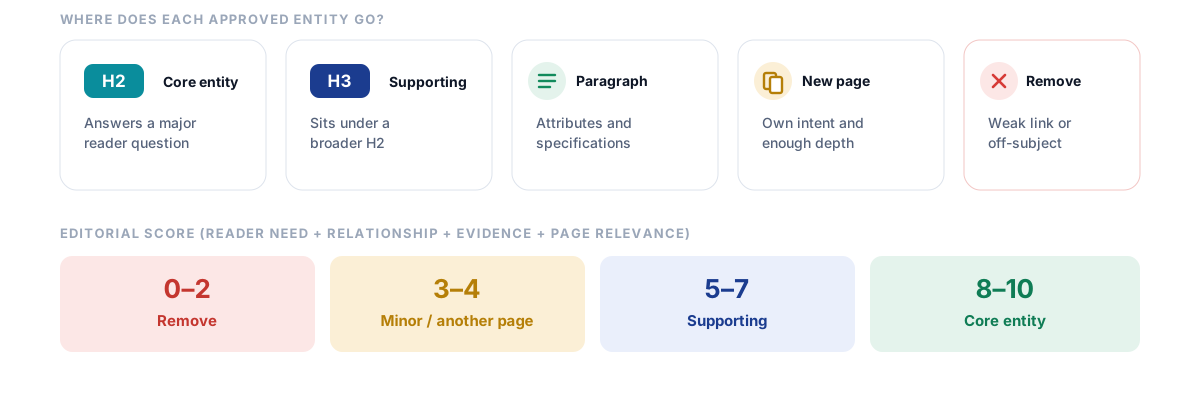
Page placement depends on reader need, relationship strength, evidence, and page focus. Assign each approved candidate to one page location. Remove candidates that weaken the main subject.
Use an H2
Choose an H2 when the entity answers a major reader question. Inverter, battery storage, and grid connection can support major solar sections. Each H2 should serve a distinct user need.
Use an H3
Choose an H3 when the entity supports a broader H2. String inverter, microinverter, and interconnection agreement can support larger sections.
Use a paragraph or list
Use a paragraph for attributes, specifications, or minor supporting details. Roof slope, shading, and power capacity can appear within suitability criteria. Lists can organize comparable attributes without creating extra headings. Maintain main-entity visibility throughout the complete content block.
Create another page
Create another page when the entity has separate search intent and enough depth. Battery storage may deserve another page covering price, capacity, backup, and compatibility.
Remove the candidate
Remove candidates with weak relationships, evidence, reader value, or page relevance. Solar farm belongs outside a residential rooftop system page.
Use the following editorial score:
- Reader need: 0–3
- Relationship strength: 0–3
- Evidence quality: 0–2
- Page relevance: 0–2
The score supports page decisions and has no connection with Google metrics. Scores from 8–10 identify core entities for the page. Scores from 5–7 identify supporting entities requiring useful coverage. Scores from 3–4 suggest minor coverage or another page. Scores from 0–2 support removal from the current page.
Example only
An inverter can score 10 through strong reader need, evidence, relationship strength, and page relevance.
A solar farm can score 4 because residential page relevance remains weak.
Write Entity Relationships Into Page Content
Entity relationships need complete sentences that serve reader questions. Each sentence should name the entity, connection, and practical purpose.
Component example
Weak example: Inverter, solar panel, battery, and grid.
Strong: The inverter converts panel-generated direct current before grid connection.
The stronger sentence states the inverter function before discussing grid connection. Department of Energy documentation supports the current-conversion relationship.
Process example
Weak process example: Permit and inspection requirements for installation.
Strong: Local authorities require permits and inspect installed rooftop solar arrays.
The sentence connects installation with approval and safety review. Local rules differ across cities, counties, states, and utilities, so authority evidence belongs near every permit and inspection claim.
Attribute example
Weak attribute example: A south-facing roof for solar.
Strong: Roof orientation affects the amount of solar energy produced.
The stronger sentence identifies an attribute relationship. It also answers why orientation belongs within suitability content.
Supporting entity example
Weak supporting example: Battery storage for residential solar systems.
Strong: Battery storage saves generated electricity for later household use.
The sentence shows why battery storage belongs within the page, and it separates storage from core generation components. Department of Energy homeowner guidance confirms that stored electricity powers the home later.
Follow six writing rules:
- Name the main entity before using pronouns.
- State one factual relationship within each sentence.
- Define unfamiliar entities during first use.
- Place evidence near technical or changing claims.
- Vary entity wording without changing identity.
- Link supporting pages where readers need deeper coverage.
Use the H1 and opening answer for the main entity. Use H2 sections for core related entities. Use H3 sections or paragraphs for supporting entities. Use criteria blocks for attributes and specifications.
Use Schema to Confirm Visible Entity Relationships
Schema can confirm visible entity roles after content verification, and markup should mirror page content and accurate relationships.
Google requires relevant, visible, and representative schema markup.
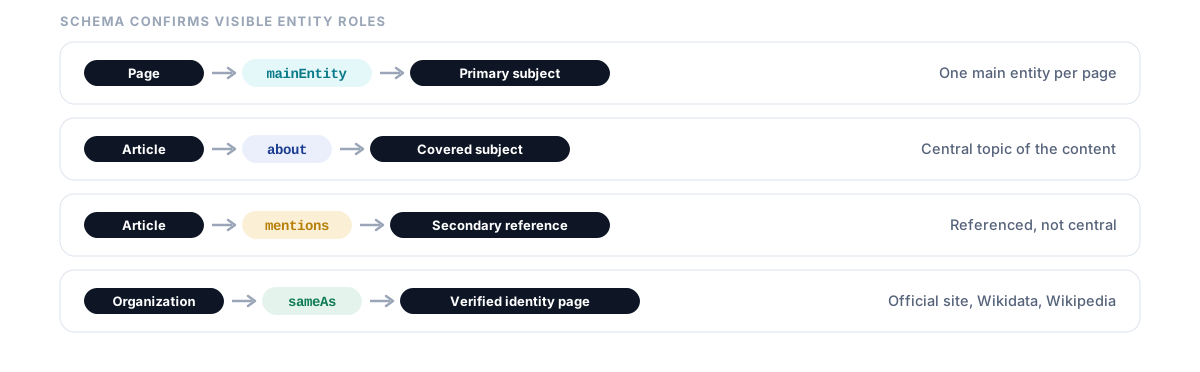
Primary page subject
Example relationship: Page → mainEntity → Residential solar photovoltaic system.
Use mainEntity for the primary entity described through a page. Adoption figures describe markup use without showing ranking effects.
Covered subject
Example relationship: Article → about → Solar inverter as a covered subject.
Use about for a central subject covered through a CreativeWork. A CreativeWork is a schema type covering articles and other created content. The property can cover several important subjects, though page focus should still identify one main entity.
Secondary reference
Example relationship: Article → mentions → Net metering as a secondary reference.
Use mentions for an entity referenced without central page attention.
Identity link
Example relationship: Organization → sameAs → verified official entity page.
Use sameAs for a page identifying the same entity without ambiguity. Suitable destinations include an official website, verified Wikidata item, or Wikipedia page. Avoid links representing related organizations or general topic pages.
Identity separation
Example relationship: Entity → disambiguatingDescription → short identity description for separation.
Use disambiguatingDescription when similar names create identity risk. The description should distinguish the entity through concise factual details.
Stable identifier
Example relationship: Product → identifier → verified product identifier for matching.
Use an appropriate ISBN, GTIN, UUID, registration number, or official identifier. Schema.org also provides specific identifier properties for many entity types.
Schema confirms visible relationships without creating unsupported associations. Google can remove rich-result eligibility when markup misrepresents page content. Rich-result eligibility describes qualification for a possible enhanced Google result, and correct markup still carries no display guarantee.
Audit Missing, Weak, and Misplaced Entities
An entity SEO audit compares approved relationships against current page coverage. Perform the audit after drafting and before schema implementation.
The audit follows seven stages:
Review the current page, 3–5 authority sources, and 5 ranking pages. Also review internal pages, Search Console queries, and product documentation. Use the approved entity map as the audit baseline.
Missing core entity
A required entity remains absent from the page. Example: a solar-system page omits inverter information.
Missing relationship
Both entities appear, but the page leaves their connection unstated. A battery mention lacks value when storage purpose remains absent. Add the factual relationship or remove the weak mention.
Missing evidence
A technical relationship appears without authority support. Add a primary source near the claim.
Wrong page
A related entity appears where another page has stronger relevance. Move deep battery-capacity information toward a storage page. Retain a concise connection within the system page. Add an internal link supporting further detail.
Ambiguous identity
One name can identify several people, organizations, products, or concepts. Add type, official URL, identifier, or disambiguating description.
Overweight supporting entity
A supporting entity receives more coverage than the main subject. Reduce the block, move it elsewhere, or strengthen main-entity focus.
Schema mismatch
Markup describes a relationship missing from visible content. Remove the markup or add accurate visible coverage. Confirm each linked entity ID and page role. Validate the final markup against Google policies. Recheck the markup after major content or template changes.
Finish the audit through 10 actions:
- Define the current main entity.
- List every candidate already present within the page.
- Classify every candidate.
- Write one relationship for each entity.
- Attach evidence beside factual relationships.
- Compare approved relationships against page coverage.
- Assign each missing entity to a suitable section.
- Move weakly related entities elsewhere.
- Remove unsupported associations.
- Recheck main-entity focus.
Measure Entity Work Without Unsupported Claims
Entity work has no universal Google score, density target, or minimum count. Measure completed editorial work separately from observed SEO outcomes. Shared timing alone cannot prove a direct causal relationship.
Work completed
Track approved relationships, authority sources, and missing coverage corrections. Track internal links, identity fixes, and removed schema errors. Those values show which editorial and technical tasks were completed.
Outcomes observed
Track related-query impressions, supporting-query clicks, engagement, and conversions. Track crawl status, indexing status, schema warnings, and panel accuracy. Those values describe observed search and business outcomes.
A content update and traffic change may happen during the same period. Other factors can affect rankings, search interest, competitors, links, indexing, and result features. Use cautious reporting without assigning unsupported causes.
Exclude these claims:
- Minimum entity counts
- Entity-density targets
- Guaranteed Knowledge Graph inclusion
- Guaranteed Knowledge Panel creation
- Fixed traffic increases
- Guaranteed AI citations
- Salience-based ranking predictions
- Knowledge Graph score interpretations
Google Cloud salience measures centrality within submitted text. Knowledge Graph resultScore measures match quality against API limits. Neither metric represents organic visibility, authority, or ranking strength.
Related Entity SEO Checklist
Use four phases for every page-level entity project. Complete each phase before publishing the content.
Define
- Name one main entity
- Identify its entity type
- State the reader task
- Create relationship categories
Discover
- Review authority sources
- Review current Google results
- Inspect ranking pages
- Review internal website evidence
Verify
- Classify every candidate
- Confirm identity and type
- Name the relationship
- Add authority evidence
- Check reader value
- Decide page location
Implement
- Build the entity map
- Write relationship sentences
- Add internal links
- Confirm visible schema
- Audit missing relationships
- Measure observed outcomes
Approve the page after relationships, evidence, placement, and markup checks. Repeat the audit after major content or product changes. Teams that would rather have this mapping, evidence, and schema handled end to end can explore our entity SEO services.
Frequently Asked Questions About Related Entities in SEO
What Are Entities in SEO?
Entities are distinct people, products, places, organizations, systems, or concepts. Each entity has an identity, type, attributes, and relationships. Search queries may name entities without becoming entities themselves.
How Do Keywords Differ From Entities?
Keywords show the wording people enter into search. Entities identify the subjects, products, people, places, or concepts discussed through content.
How Can I Find Related Entities for SEO?
Start with authority sources, Google results, Wikidata, Knowledge Graph Search, competitor pages, and internal evidence. Classify each candidate before approving any relationship or placement. Name the relationship and attach an authority source. Decide page placement through reader value and focus.
How Do I Find Entities for SEO Optimization?
Define one main entity, then collect candidates from trusted sources. Confirm each identity, name the relationship, and attach supporting evidence. Assign every approved entity to one useful page section.
Is Every Related Search an Entity?
Related searches provide candidate queries, topics, attributes, entities, and modifiers. Confirm identity and relationship through another source before adding any candidate.
Does Entity Salience Affect Rankings?
Google Cloud salience measures entity centrality within submitted text. It cannot measure ranking probability, authority, topical completeness, or AI citation probability.
Does Wikidata Guarantee a Knowledge Panel?
Wikidata can support identity and relationship research. Inclusion cannot guarantee a Google Knowledge Panel or organic ranking benefit.
Does Schema Markup Create Entity Relationships?
Schema confirms visible relationships already supported through page content. Google requires relevant and visible schema markup. Unsupported associations can remove eligibility for relevant enhanced features.

Manish Singh is Head of Generative AI at SEO Noida and has 14+ years of experience in SEO, UX, and digital marketing. He focuses on how Google and AI platforms find, interpret, and cite web content. His articles cover AI SEO, GEO, AEO, LLM SEO, entity optimization, content architecture, and visibility measurement, drawing on website audits and campaign work.