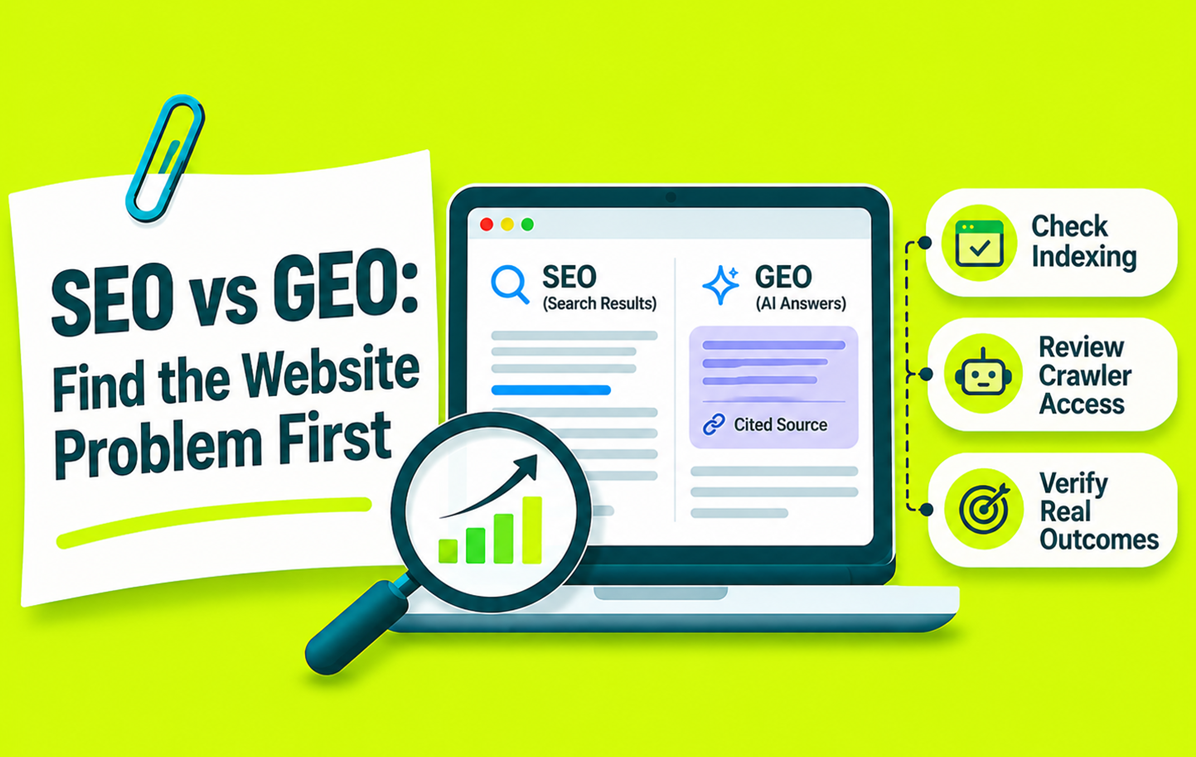
A website can earn organic visits without appearing in AI citations. Another page may receive citations without generating customer enquiries. Those situations call for different checks and different content work. Treat each signal separately before adding more pages or keywords.
SEO and GEO Measure Different Results
SEO covers search access, relevance, useful content, and organic visibility. GEO adds questions about AI-generated answers and source inclusion. AI responses may contain citations, ordinary links, or named businesses. The same website can serve both forms of discovery. Each result needs a suitable measurement method.
Google draws a stronger connection between both approaches than marketing labels suggest. Its official AI Search guidance describes GEO and AEO as terms within search optimization. AEO, short for Answer Engine Optimization, focuses on answering questions directly. None of these names creates a guaranteed new ranking method.
Search impressions indicate exposure, while clicks show visits from results. AI citations indicate a page appeared as a referenced source. Neither observation proves that a customer bought anything. Compare each signal with the website action you actually want.

A Missing AI Citation Needs a Diagnosis
A missing AI citation alone cannot identify the cause. The page might be inaccessible, irrelevant, or outside the answer selection. A reporting account may also lack enough observations for analysis. Rewriting a page immediately can waste the available evidence.
First inspect the actual page and its search eligibility. Next check the questions the page genuinely answers. Then review supported AI reporting for the same topic. Record unavailable data as unknown without assuming poor content.
A competitor appearing in one generated answer offers limited proof. Google states that AI responses and supporting links can vary. Compare dated observations before making any substantial content change.
Google AI Visibility Starts With Search Eligibility
Google AI Overviews and AI Mode use core Search systems. A source page needs indexing and eligibility for Search snippets. Google documents those requirements without prescribing special GEO markup. An accessible page still has no guaranteed placement in answers.
Inspect the chosen URL in Search Console before revising paragraphs. Check indexing, crawling, canonical selection, and readable page content. Examine relevant internal links before starting another content refresh.
Google also offers a Search generative AI participation control. The control and related reporting reached websites worldwide on August 31, 2026. Google describes the control separately from ordinary Search ranking eligibility.
An excluded website may miss generative AI impressions despite useful content. Better headings cannot override an intentional publisher exclusion. Confirm access and publishing preferences before changing the message.
ChatGPT and Bing Require Separate Publisher Checks
Google access alone cannot establish eligibility across other AI systems. OpenAI and Microsoft publish their own crawler and content-use controls. Those controls distinguish search discovery, training, and AI grounding.
ChatGPT Search and Model Training Use Different Bots
OpenAI identifies OAI-SearchBot as its search discovery crawler. GPTBot concerns model training under separate crawler controls. OpenAI documents these roles and their publisher options. A training restriction alone does little to determine search eligibility.
Review the actual robots.txt rules for both bot names. Compare the configuration with the website publication policy. A crawler permission permits discovery under relevant conditions, without promising citations. Other AI assistants may operate under different access rules.
Microsoft AI Grounding Rules Change in February 2027
Microsoft announced separate AI Training and AI Grounding preferences on October 30, 2026. The new preferences begin taking effect during crawling from February 1, 2027. Microsoft published the timetable alongside separate content-use choices. Traditional Bing search eligibility follows its own indexing requirements.
AI Grounding controls how page information supports generated responses. Training preferences govern a different use of publisher content. Existing NoArchive or NoCache configurations need attention before March 1, 2027.
The announced rules concern future dates beyond November 2026. Record existing directives before planning their replacements. Any publisher preference change belongs to an authorized website owner.
Original Page Facts Answer Buyer Questions
The strongest GEO improvement may already belong inside ordinary SEO content. A service page should answer the questions customers use when choosing. Generic claims about quality offer little help without exact conditions. Google recommends unique, experience-backed information beyond common descriptions.
Consider an AC installation page for one city. A reader needs covered areas, appointment availability, and service scope. They may ask about removal, site inspection, and warranty terms. The business must confirm each detail from its actual records. That evidence makes the answer useful for a purchase decision.
An editor can answer related questions within natural paragraphs. One section describes included work and relevant exclusions. Another covers appointments using verified business information.
A page containing familiar sales phrases offers few useful distinctions. More definitions of GEO would offer even less value. Verified business details create substance that another writer cannot invent.
Google and Bing Report Different AI Results
AI visibility reports support decisions once their scope is known. Google measures appearances within its generative Search experiences. Bing reports citations within supported Microsoft and partner AI surfaces. Ordinary conversion data still needs separate collection.
Google Reports AI Impressions Across Websites
Google introduced separate generative AI performance reports in June 2026. Their worldwide rollout finished on August 31, 2026. Google Search Console documentation describes impressions, pages, countries, and devices. Search and Discover have distinct reporting views. Some properties may lack enough activity for useful figures.
These reports describe exposure within AI Overviews and AI Mode. They contain no separate detailed customer-conversion measure. Compare the figures with visits and confirmed website actions.
Bing Reports Citations and Topic Opportunities
Bing AI Performance reports cited pages and sampled grounding queries. Grounding queries identify topics behind generated answers. Bing also offers Citation Share and Compare in preview. Those measures describe AI source appearances, excluding customer purchases. Their reported values need the published product-specific qualifications.
Bing Topics Portfolio beta groups related queries into themes. Opportunity queries identify topics citing other sites without yours. Its topic classification and estimated volumes remain approximate. Some websites may lack enough activity for the feature.
Use those observations to investigate specific unanswered questions. Avoid changing ten pages after one citation fluctuation. Confirm useful source information before expanding article coverage.
Four Observations Point to Four Different Actions
The correct next task depends on the available evidence. A missing page and a missing citation describe different problems. A cited page with weak business results needs another investigation.
| Observable result | First useful check | Editorial or technical action |
|---|---|---|
| Important page missing from Google Search | Index status, robots rules, canonical URL, page access | Correct the discovery barrier before rewriting copy |
| Page indexed but customers lack essential answers | Product or service facts, exclusions, reader questions | Add verified information that resolves an actual decision |
| Page searchable but absent from observed AI citations | Publisher controls, relevant questions, report scope | Investigate eligibility and answer relevance without assuming a penalty |
| Page cited or visited without enquiries | Landing-page task, contact options, conversion evidence | Improve the customer journey after reviewing actual visits |
The matrix illustrates a diagnostic method without measured case outcomes. Its first two checks concern access and useful information. The other checks concern AI reporting and business activity.
For one page, document the observation and supporting source. Select one correction with a defensible reader benefit. Preserve the earlier version and later performance records. Compare similar periods before attributing a change to your edit. That comparison can reveal the next worthwhile improvement.
Test One Page Before Expanding the Work

Choose an existing page with one important reader question. Record its indexed status and available search performance first. Identify the factual or access problem you can actually verify.
Correct that issue while preserving the original page purpose. Document the business record supporting each important new claim. Record the date and owner of any crawler change. Avoid changing titles, page ownership, and service promises together without evidence.
Review later results using comparable time periods and reporting scopes. Impressions, citations, visits, and enquiries can move independently. Expand the work only after the evidence supports another decision.

Manish Singh is Head of Generative AI at SEO Noida and has 14+ years of experience in SEO, UX, and digital marketing. He focuses on how Google and AI platforms find, interpret, and cite web content. His articles cover AI SEO, GEO, AEO, LLM SEO, entity optimization, content architecture, and visibility measurement, drawing on website audits and campaign work.