The ecommerce SEO case study examines brand disambiguation, ecommerce schema markup and merchant data across one documented Satvikly case. First-party records establish the starting point, completed work and later Google profile observation. Google documentation supplies the platform context. The case separates recorded facts from causal claims.
Google Showed Satvikly While Suggesting Satvik as a Spelling Correction
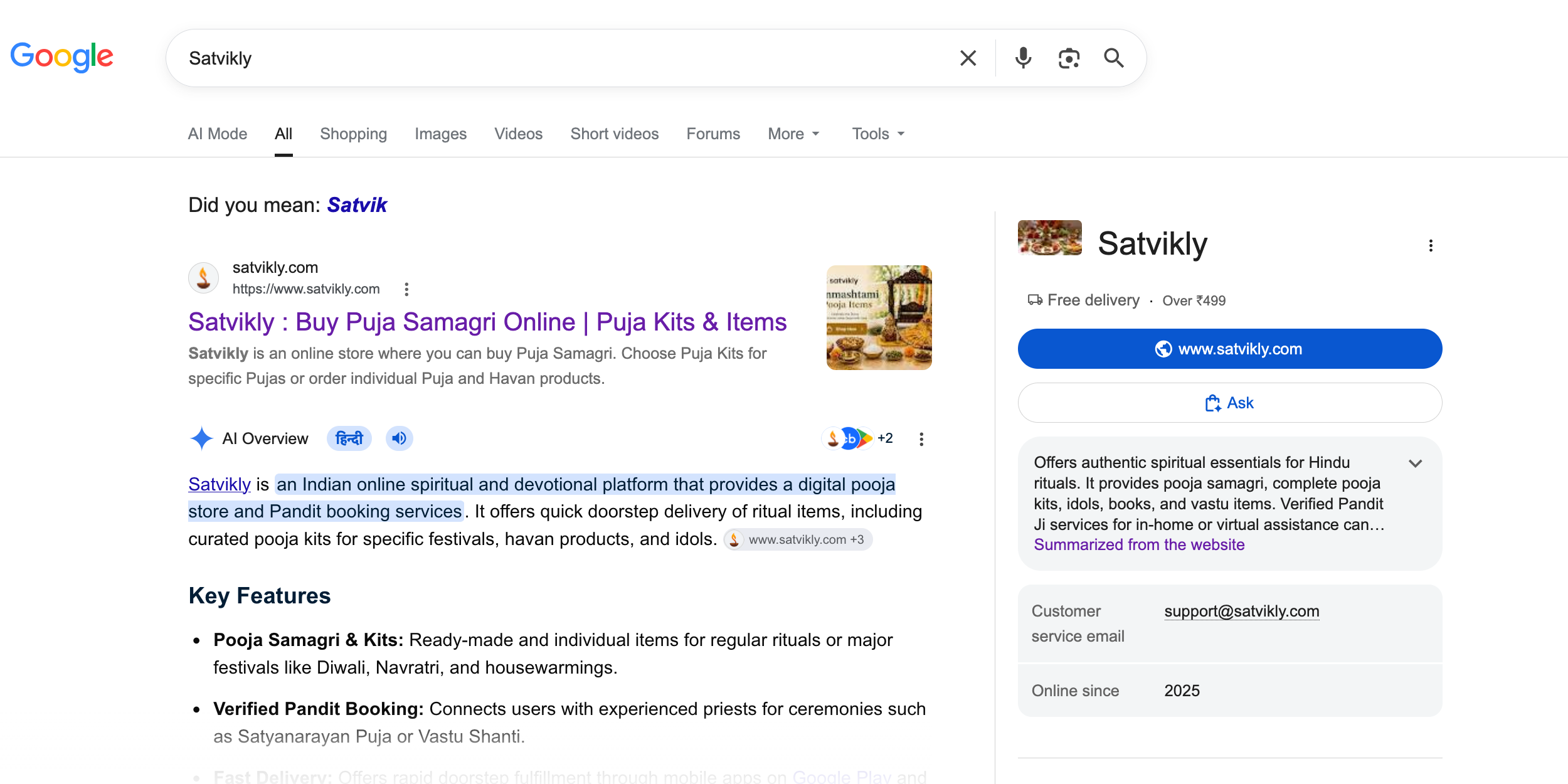
Google showed Satvikly as a distinct Brand Profile. The same query also suggested Satvik as a spelling correction. Both observations appeared on the same SERP, yet neither proves an internal Google entity merge.
google.com/search?q=Satvikly
Brand Profile or Merchant Knowledge Panel?
The captured card matches Google Brand Profile documentation. Brand Profiles can show business descriptions, images, shipping details and merchant information. Google also directs eligible brands to search their exact business name when locating a Brand Profile in Search.
Search Central uses merchant knowledge panel terminology for merchant Organization information. Google describes classic Knowledge Panels as automatically generated from web sources. Brand Profile describes the captured Satvikly card more precisely.
The Ask button supports the merchant classification. Google documents Business Agent inside Brand Profiles. The feature can use Merchant Center shopping data together with company website information.
The Satvik Spelling Suggestion Shows Residual Name Ambiguity
The spelling correction shows residual name ambiguity around Satvikly. Google still displayed Satvikly as its own result and Brand Profile. Earlier SEO Noida research had identified similar Satvik names. The research required Satvikly across the homepage, markup and official profiles.
A separate Satvik Store also sells Puja products within the same market. The overlap makes exact Satvikly naming commercially useful. Available evidence never shows Google merging Satvikly with another brand.
Entity disambiguation here concerns one practical problem: distinguishing Satvikly from similar Satvik names. The case shows ecommerce brand recognition before spelling ambiguity disappeared.
Satvikly Already Ranked for Its Brand Query Before the Homepage Rewrite
The Satvikly homepage already appeared for its brand query. SEO Noida started with an indexed brand already visible in Search. The baseline problem concerned homepage focus across products and services.
The Homepage Mixed Puja Products and Pandit Services
Earlier homepage content mixed Puja products with Pandit services. Books, Astrology, Vastu, Rakhi and broader devotional content also appeared. A visitor had to process several different offers on one page.
SEO Noida research centered the intended homepage on Puja Samagri products. Google already returned the domain for its brand query. Brand discovery and business definition represented separate problems.
A Similar Satvik Brand Already Operated in Puja Commerce
Separate Satvik branded commerce already existed around ritual products. SEO Noida used Satvikly as the exact brand form across controlled brand fields. The baseline contained two commercially related names: Satvikly and Satvik.
Exact brand naming had a case-specific disambiguation purpose. Available evidence provides no historic Google entity-merge record.
We Reworked the Homepage Opening Around Satvikly as a Puja Ecommerce Brand
SEO Noida changed the opening from broad spiritual commerce to Puja products. The revised opening centers Puja Samagri, Puja Kits and Havan products.
The live Satvikly homepage opens around Puja ecommerce, yet broader content appears deeper on the page. Current sections include books, Rakhi, Astrology, Vastu and Pandit profiles. The homepage opening carries the product-first definition before those broader categories and services.
Organization, WebSite and sameAs Declared Entity Relationships
The implementation specification included WebSite and Organization for the homepage. It also required the canonical homepage URL and consistent Satvikly naming. SEO Noida later confirmed Organization, WebSite and sameAs deployment.
Satvikly Used the Same Brand Name Across Copy and Markup
The implementation specification uses Satvikly across copy and schema. H1, WebSite, Organization, footer and official profiles use the exact brand form. Related research rejected shortened brand forms such as Satvik.
WebSite
Organization
footer
official profiles
Satvikly
Exact name parity removes self-created naming variants. One stable brand form now spans visible copy and schema fields.
Merchant Center Showed the Satvikly Website as Verified and Claimed
Merchant Center shows satvikly.com as Verified and Claimed. The screenshot supplies no start timestamp for either status.
Google requires website verification before a Merchant Center account can claim an online store URL. The capture confirms a Merchant Center relationship with satvikly.com.
Brand Profile claiming follows a separate Search workflow. The screenshot never proves Satvikly claimed or managed the Brand Profile.
The Google Profile Displayed Shipping, Support Email, Website and Ask
The profile shows free delivery over ₹499, support email, website access and Ask.
Google Brand Profile documentation includes business information and shipping details among supported profile content.
Google documents Ask through Business Agent on merchant Brand Profiles. The feature can use Merchant Center shopping data together with company website information. Available sources never identify the origin of every Satvikly field.
The shipping threshold also appears on the Satvikly website. The match records consistency across two visible surfaces. The source behind that Google field remains unknown.
Merchant Data Covered Commerce Facts While Markup Defined Brand Identity
Entity markup records the brand name, organization, website, canonical page and identity references. Merchant Center records commerce context linked with the online store account.
Google Brand Profile source documentation lists Merchant Center and the official website among profile sources. Google can also use schema.org markup when collecting public website information. The case contains both website identity data and merchant data.
Google Profile Included Pandit Services While the Homepage Opening Focused on Puja Products
Google profile text includes Pandit services, while the homepage opening centers Puja products. Later homepage content includes Pandit profiles and broader categories. Books, Rakhi, Astrology and Vastu remain visible on the live site.
| Surface | Public Satvikly scope |
|---|---|
| Homepage opening | Puja products and Havan products |
| Later homepage sections | Products, books, Rakhi, Astrology and Vastu |
| Satvikly service pages | Pandit and ritual services |
| Google Brand Profile | Products and Pandit services |
Satvikly also publishes pages for Pandit and ritual services. Different pages describe different parts of the same ecommerce brand.
Google can source Brand Profile information from the official website and other public sources. A broader profile description can draw from several possible sources.
One Satvikly case never establishes a universal Google rule about description variance.
Satvikly Evidence Sequence: Audit to Google Profile Capture
The baseline audit and implementation specification form separate first-party records. Our implementation record confirms Organization, WebSite and sameAs deployment. Merchant Center supplies an online store account record. The Google screenshot supplies the profile observation.
An earlier SERP screenshot showing profile absence would support a stronger first-appearance claim. The current evidence set lacks that screenshot.
search.google.com/search-console/performance
Which Satvikly Changes Have a Documented Google Connection?
Google documentation covers several elements used in the Satvikly work. The records never isolate one cause.
Organization Schema and Entity Disambiguation
Google documents Organization schema for organization disambiguation. Search Central also links merchant Organization properties with merchant knowledge panel and Brand Profile details.
Satvikly implemented Organization markup during the homepage work. Google publishes no Satvikly-specific contribution data.
Google structured data policies provide no appearance guarantee after valid markup implementation.
Did Organization schema create the Brand Profile?
The case file never isolates it. The supported claim is narrower: Organization markup existed before the first supplied profile capture.
Brand Profiles Can Use Merchant Center, Websites and Public Sources
Google Brand Profile source documentation lists Merchant Center, official websites, licensed data, user contributions and public information. Google can also create profile descriptions from website content. Schema.org markup can supply public website information.
Satvikly case records contain Merchant Center evidence, website content and schema markup. Available sources never reveal licensed-data contribution, user contribution or source weighting for Satvikly.
The case contains several source types listed in Google documentation. Their individual contribution remains undisclosed.
The Records Leave the Main Cause Unresolved
Several sources could contribute to the profile. The records never isolate website content, Merchant Center, public references, external records or Google processing.
The case file contains no experiment isolating one input. Chronology shows sequence without assigning contribution percentages.
Did Merchant Center create the profile?
The same evidence limit applies. Merchant Center had a documented relationship with satvikly.com, yet Google lists other Brand Profile sources.
Claims Beyond the Evidence
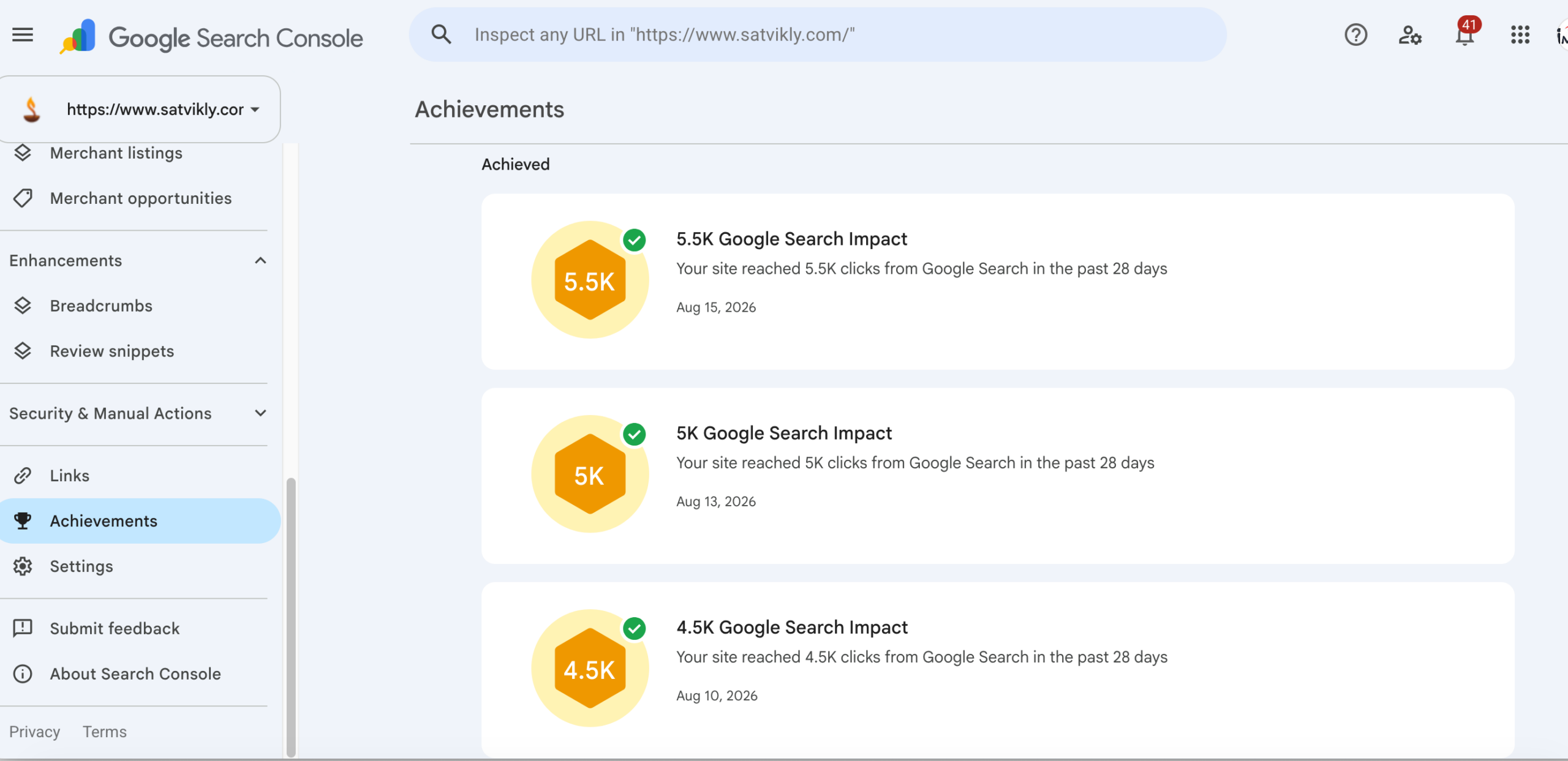
Available proof supports no sole-cause claim. Organization schema, sameAs and Merchant Center each lack sole-cause proof. The profile also supplies zero traffic-growth evidence.
The supported case statement is narrower. SEO Noida revised the homepage opening, standardized exact brand naming, implemented entity markup and documented Merchant Center linkage before the first supplied profile capture.
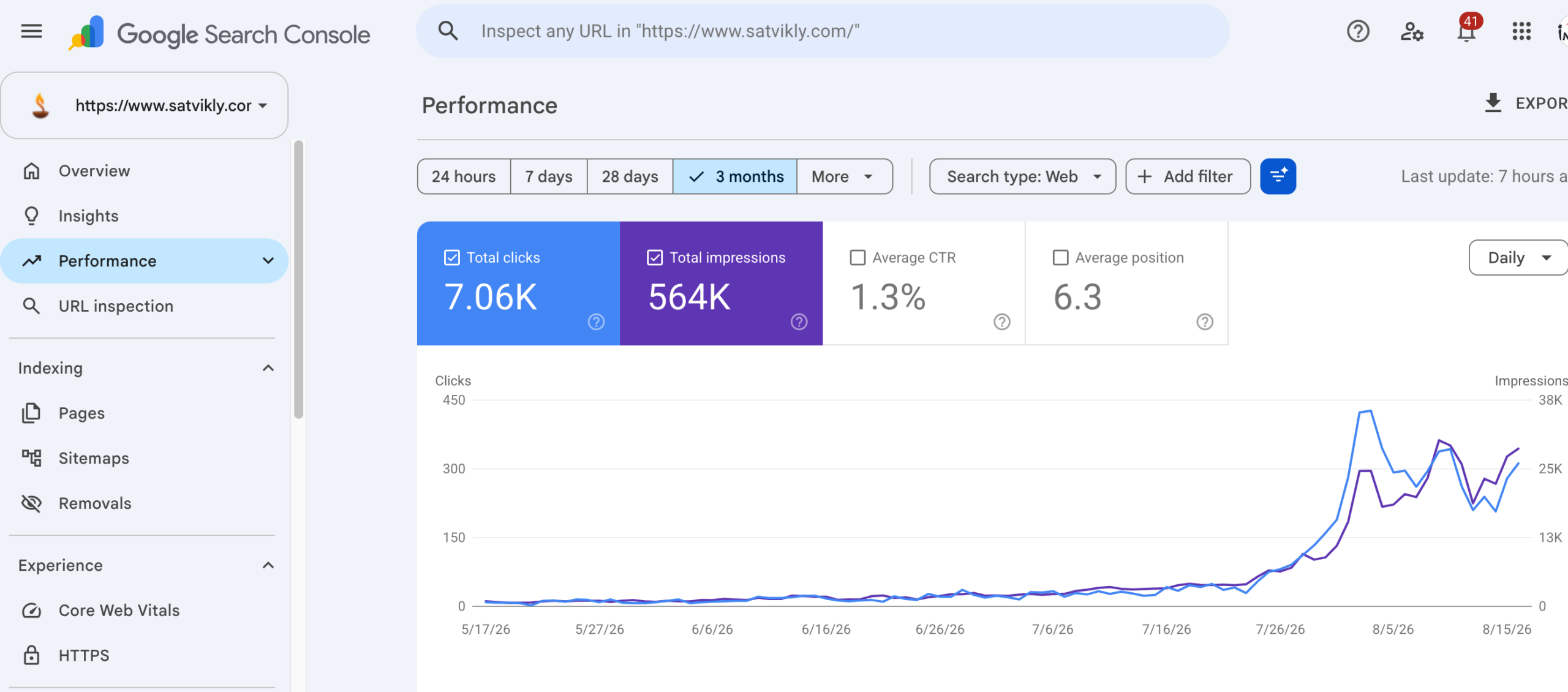
The aggregate Search Console graph remains outside the outcome claim. It measures broader site Search performance without isolating the Brand Profile.
search.google.com/search-console/achievements
Evidence Standard for a Defensible Google Knowledge Panel Case Study
A defensible case starts with a baseline SERP before intervention. Each record should separate observation, implementation, source and claim limits.
Satvikly lacks an earlier SERP capture showing profile absence. The missing screenshot blocks any first-appearance claim. Future case studies should archive the branded SERP before intervention begins.
The case separates recorded facts from causal claims.

Manish Singh is Head of Generative AI at SEO Noida and has 14+ years of experience in SEO, UX, and digital marketing. He focuses on how Google and AI platforms find, interpret, and cite web content. His articles cover AI SEO, GEO, AEO, LLM SEO, entity optimization, content architecture, and visibility measurement, drawing on website audits and campaign work.