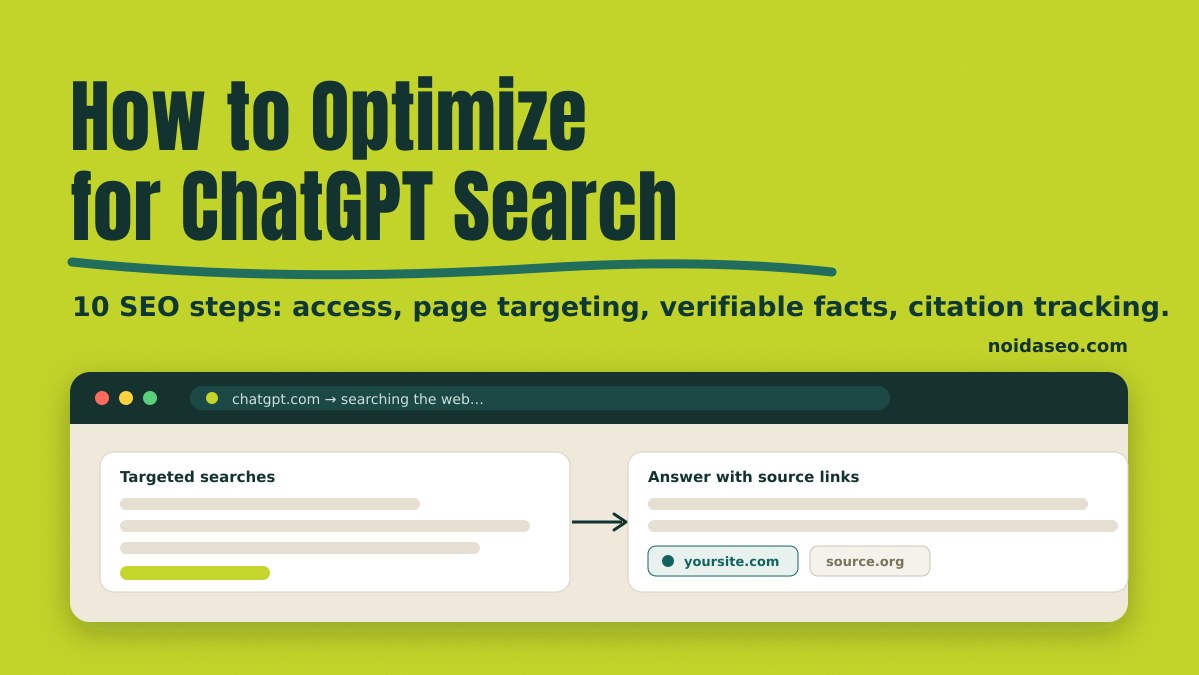
ChatGPT Search optimization starts by allowing OpenAI to crawl priority pages and matching important questions to the right pages. Then publish verifiable facts, cover related questions, and measure citations and referrals against a baseline.
ChatGPT Search can rewrite a prompt into one or more targeted searches. It can send narrower searches after reviewing earlier results. Location and Memory can also affect the searches ChatGPT sends.
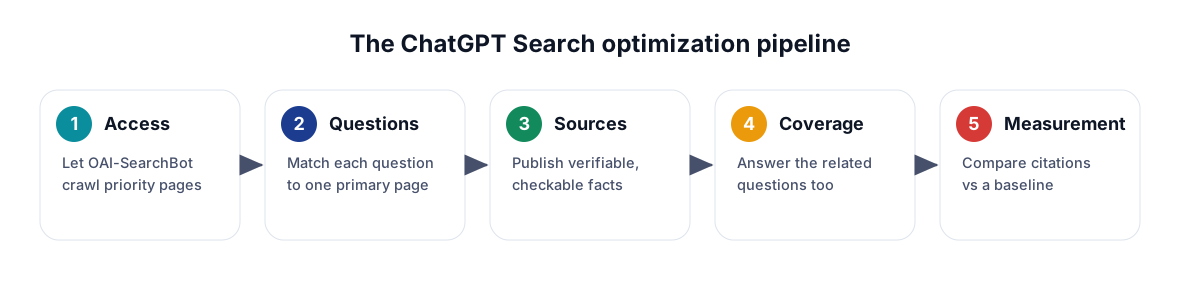
Takeaways
- Allow OAI-SearchBot on pages targeting ChatGPT Search.
- Keep GPTBot separate from automatic Search crawling.
- Group similar prompts around the same question.
- Give each distinct question or task one primary page.
- Improve facts before changing paragraph or FAQ formats.
- Treat undocumented ranking claims as unproven.
- Track citations, mentions, referrals, and conversions separately.
What Can Publishers Influence in ChatGPT Search?
Publishers control whether OpenAI can crawl a page and what the page answers. They can add verified facts, cite outside evidence, and measure what happens.
OpenAI chooses the searches, sources, citation placement, and final response.
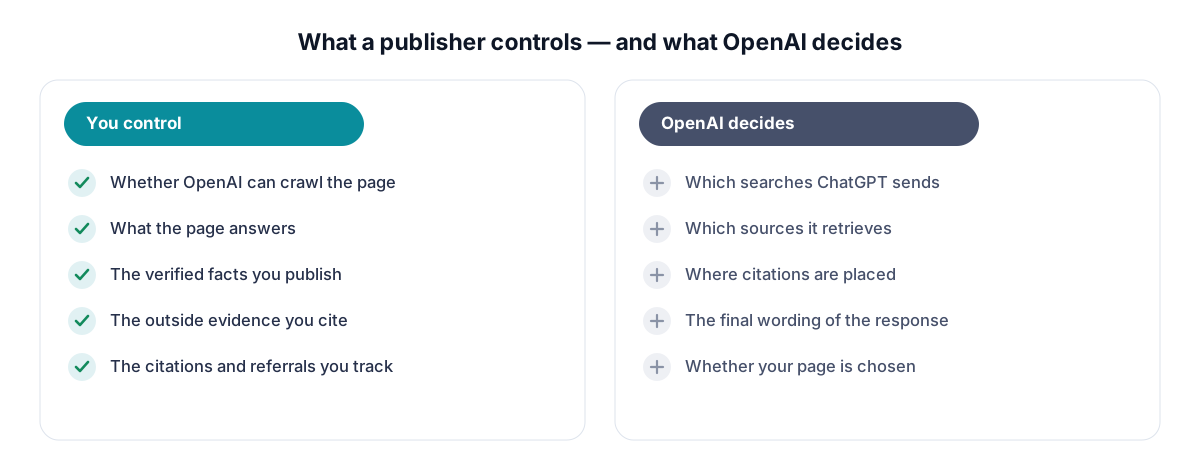
Technical teams can verify crawler access. Editors can define the page topic and add missing facts. Analytics teams can track citations, mentions, referrals, and conversions.
OpenAI says Search ranking considers several factors related to reliability and relevance. Top placement is not guaranteed.
How ChatGPT Search Finds Web Sources
ChatGPT Search can turn a prompt into one or more targeted searches. It can send more specific searches after reviewing earlier results. OpenAI lists Bing and Shopify among services that can support Search.
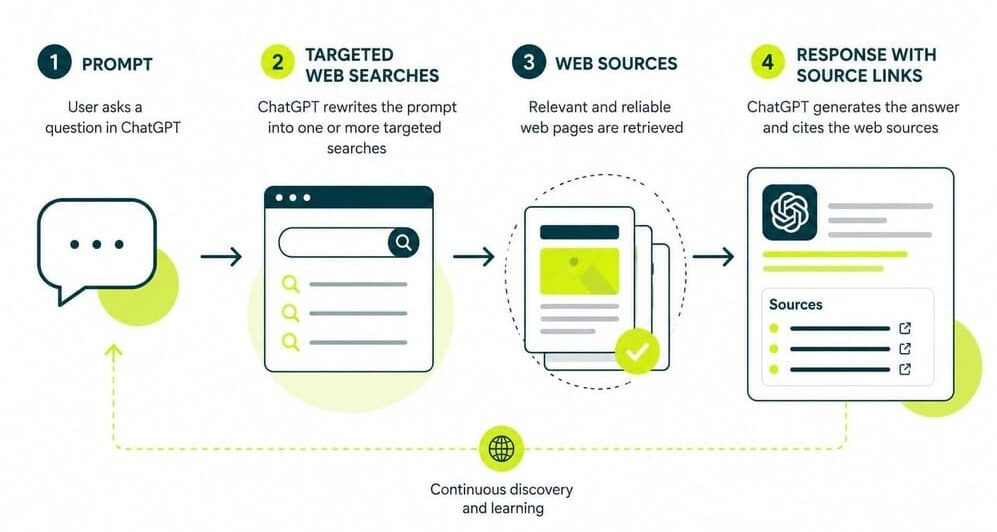
OpenAI documents targeted searches and source links. It does not publish how retrieved sources are weighted.
Location can affect local searches. Memory can add relevant context when enabled. Similar wording can therefore lead to different searches.
For example, a restaurant query from Delhi may need local results there. The same wording from London can lead to a different search.
Make Priority Pages Eligible for ChatGPT Search
Check crawler access before editing content. A content rewrite cannot fix a page that OpenAI cannot fetch.
Step 1. Allow OAI-SearchBot
OAI-SearchBot handles automatic Search crawling. OpenAI tells publishers seeking ChatGPT Search inclusion to allow the crawler.
Example robots.txt rule:
Check server, firewall, and CDN rules too. Robots permission does not help if infrastructure blocks verified crawler requests.
OpenAI publishes IP ranges for OAI-SearchBot. Robots.txt changes may take about 24 hours to affect OpenAI systems.
Crawler access is only the first check.
A successful crawl shows that OpenAI can reach the URL. Retrieval, citation, placement, and referral are separate.
Server logs can confirm the requested URL, response status, user agent, and crawler IP.
Step 2. Separate Search Crawling From Training Access
OAI-SearchBot handles automatic Search crawling. GPTBot covers content that may contribute to model training.
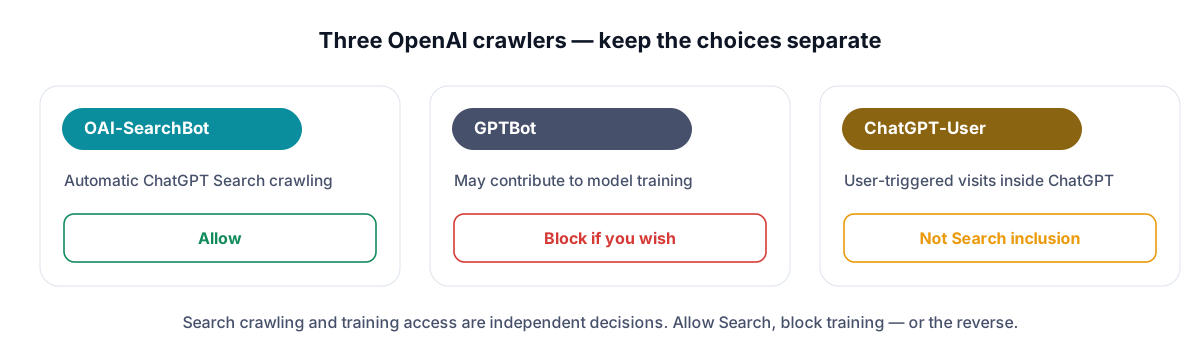
ChatGPT-User handles certain visits started by a user inside ChatGPT. OpenAI says ChatGPT-User does not control automatic Search inclusion.
A publisher can allow OAI-SearchBot while blocking GPTBot. Search crawling and training access are separate choices.
Step 3. Check Access on Priority URLs
Check important URLs one by one. Domain-level crawler permission can pass while a valuable page still fails.
Inspect the final HTTP response and path-specific robots rules. Check CDN behavior, firewall rules, exclusion directives, and public page content.
OpenAI also asks publishers to accept OAI-SearchBot traffic from its published IP ranges.
Illustrative example
Robots.txt permits OAI-SearchBot across a site. A CDN challenge blocks requests to
/pricing/. Domain permission passes, but the pricing page remains inaccessible.
Fix the CDN block before rewriting the page.
If crawling works but the page still does not appear, check query match, competing sources, and entity information. A deeper ChatGPT visibility diagnosis covers those checks in more detail.
Match ChatGPT Searches to the Right Pages
After crawler access works, match each important question to the page that answers it.
Step 4. Group Prompt Variants Around Reader Intent
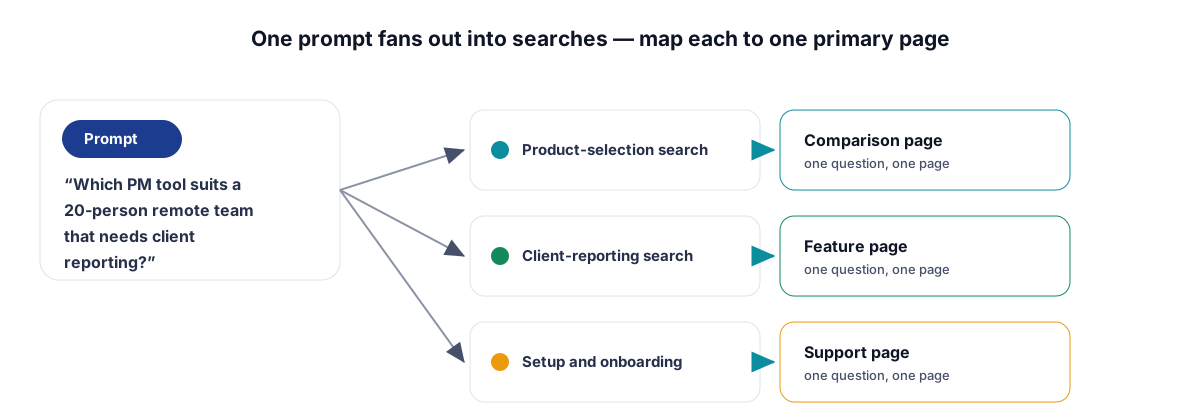
ChatGPT prompts can combine several conditions in one request. Because Search can rewrite the prompt, one exact keyword cannot represent every search it may send.
Example SaaS prompt:
Which project management platform suits a 20-person remote software team that needs client reporting?
The request specifies a software category, team size, remote work, client reporting, and product choice. Those details can produce different searches around one broader question.
A comparison page might answer the product-selection question. A feature page might answer questions about client reporting. A support page might cover setup after purchase.
Plan pages around actual questions people ask, not presumed query strings.
OpenAI confirms that ChatGPT can send one or more targeted searches. It does not publish a fixed number.
Step 5. Choose One Primary Page for Each Different Question
Closely related questions can share one page when the reader wants the same answer or action. Separate pages become useful when the required result changes.
SOC 2 provides a simple example. A reference page can define SOC 2. A preparation page can cover readiness work. A comparison page can evaluate compliance platforms.
All three pages belong to the same broad topic. Each answers a different question.
The title, H1, URL, opening answer, and sections should all point to the same topic.
Too broad
Title: AI Productivity Platform
H1: Work Better With AI
URL:/solutions/ai/
More specific
Title: AI Meeting Notes for Sales Teams
H1: AI Meeting Notes for Sales Call Follow-Up
URL:/ai-meeting-notes-sales/
The second example tells readers exactly what the page covers. It does not represent a documented ChatGPT ranking factor.
When two pages answer the same question, choose one as the primary page before adding another URL.
Make Retrieved Pages More Useful
A retrieved page still needs enough useful facts to support the answer.
Step 6. Publish Verifiable Facts That Help the Reader Decide
Replace broad marketing claims with specific facts a reader can check.
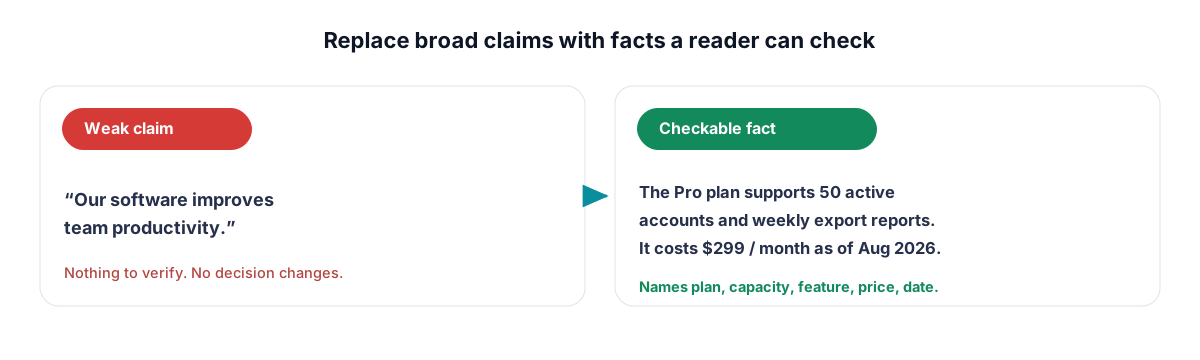
Weak statement
Our software improves team productivity.
Illustrative stronger statement
The Pro plan supports 50 active accounts and includes weekly export reports. It costs $299 per month as of August 2026.
The values are hypothetical. The example names the plan, capacity, feature, price, and date.
Include details that could change the reader’s decision.
A cloud-backup page may need retention period, restore time, storage location, and encryption details. Account limits and cancellation terms may also affect the choice.
A product comparison needs shared criteria and relevant exclusions. Technical instructions may need prerequisites, expected results, and failure checks.
Numbers need context. Give a percentage’s denominator when readers need it to understand the number. Name the criteria behind a comparison. Date facts that can change.
First-party results need enough method and context for readers to judge the claim.
A 2026 cross-platform citation study analysed 602 controlled prompts. Researchers reviewed 21,143 search-layer citations and 18,151 fetched pages.
Citation breadth and source influence differed across the dataset. Pages with higher influence tended to contain more extractable facts and procedures.
The study covered ChatGPT, Google AI systems, and Perplexity. It does not establish a ChatGPT ranking formula.
Depth test
Keep a detail when removing it could change the reader decision.
Step 7. Prioritize Relevance Before Format Tricks
Improve question match and missing facts before changing page format. Add evidence, comparison criteria, and updated details when they affect the answer.
A 2026 controlled experiment placed two candidate sources inside model context. Researchers then ran 252,000 paired trials across six LLMs.
Topical relevance and source position had the largest effect on which source was cited first. Formatting-only changes had little impact in that setup.
Study boundary
Both candidate sources had already entered model context. The experiment measures source competition after retrieval, not organic ChatGPT Search discovery.
Spend more effort on question match, missing facts, evidence, useful comparisons, and sound first-party research.
Fixed paragraph lengths deserve less priority. The same applies to forced FAQ blocks, repeated question headings, and machine-shaped text chunks.
Choose format based on the information. Comparisons need shared criteria. Procedures need ordered steps. Definitions need precise boundaries.
Separate ChatGPT Evidence From SEO Folklore
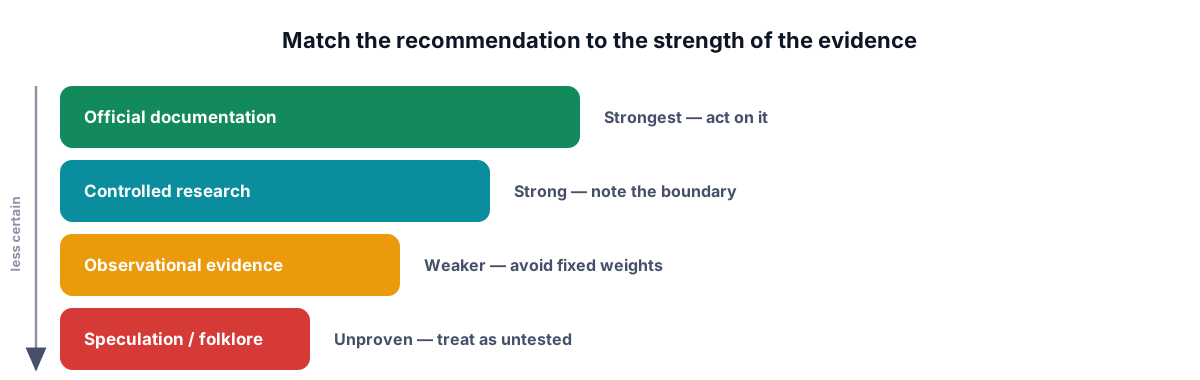
ChatGPT SEO advice mixes official documentation, experiments, observations, and speculation. Stronger evidence should support stronger recommendations.
| Claim | Evidence | What It Supports | Action |
|---|---|---|---|
| OAI-SearchBot access | OpenAI documentation | Search crawler eligibility | Allow access |
| GPTBot for Search | OpenAI documentation | Potential training access | Keep separate from Search |
| Bing-only optimization | OpenAI documentation | Bing can support some searches | Do not optimize only for Bing |
| JSON-LD schema | Matched intervention | No significant citation increase in studied pages | Keep schema for normal SEO uses |
Publisher llms.txt |
OpenAI Search documentation reviewed here | Search inclusion focuses on OAI-SearchBot and host access | Do not treat it as a Search requirement |
| Fixed passage length | Public documentation and controlled research | No fixed optimum is established | Avoid numeric formulas |
| FAQ formatting | Public OpenAI documentation | FAQs can answer genuine questions | Add only when needed |
| Reddit or brand mentions | Observational evidence | External discussion can verify public facts | Avoid fixed-weight claims |
| Freshness | Depends on the query | Changing facts need review | Refresh after factual change |
OpenAI’s crawler documentation defines OAI-SearchBot, GPTBot, and ChatGPT-User. Search documentation explains query rewriting and provider relationships.
The public Search documentation does not publish fixed weights for paragraph length, FAQs, backlinks, or external mentions.
Does Schema Increase ChatGPT Citations?
An Ahrefs matched intervention did not find a significant ChatGPT citation increase after pages added JSON-LD.
Researchers tracked 1,885 pages that added JSON-LD. They compared those pages with 4,000 controls.
The estimated ChatGPT citation change was 2.2 percent. The result was statistically indistinguishable from zero.
The sample focused on pages that already received substantial AI citations. The finding therefore does not settle every schema scenario.
Schema still supports structured data for standard search features. This study does not show that adding schema increases ChatGPT citations.
Is There an Ideal Passage Length for ChatGPT?
OpenAI does not state a publisher passage-length target in its public Search documentation.
Controlled citation research also found little effect from formatting-only changes after sources were already inside model context.
Write for the information being presented. Comparisons need common criteria. Procedures need an ordered sequence. Definitions need exact boundaries.
Build Visibility Across the Whole Topic
One page can answer its main question well while related questions remain unanswered.
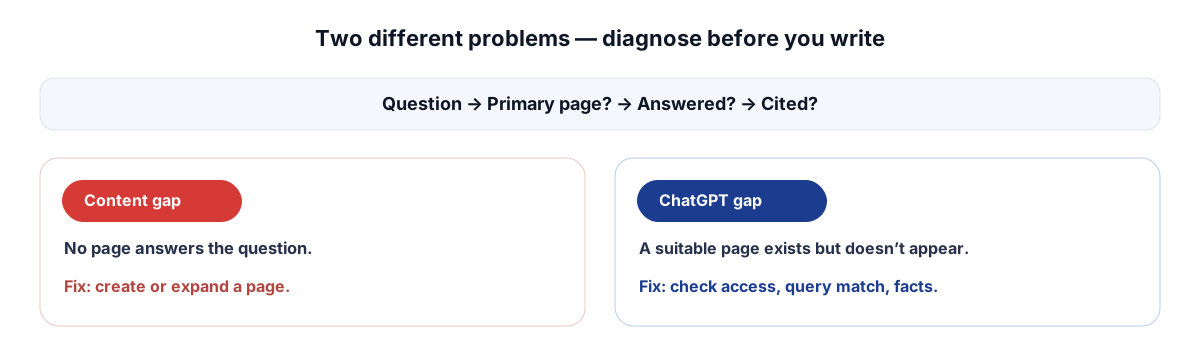
Step 8. Separate Missing Content From Missing ChatGPT Visibility
List the important questions around the topic. Assign a primary page to each different question or task.
For each question group, record the question, its primary page, whether it is answered, whether it is cited, and whether the brand is mentioned.
This separates two problems.
Content gap: no page answers the question.
ChatGPT gap: a suitable page exists, but it does not appear in tested results.
Create or expand content for a content gap.
For a ChatGPT gap, check crawler access and query match first. Then compare the page’s facts with competing sources and review the test conditions.
Prioritize unanswered questions that can change a reader decision. Minor wording variations can wait.
Step 9. Add Independent Evidence When It Verifies a Fact
Your website can publish first-party facts. Independent sources can verify claims that need outside confirmation.
Consider a regulated business. Its website can state its services and operating locations. A regulator can confirm licence status.
Each source proves something different.
Editorial reporting can confirm events or public claims, while reviews can document customer experience. Authoritative directories can verify business details, and comparison pages can supply outside criteria.
OpenAI’s public Search documentation does not state a fixed ranking weight for external mentions.
Add independent sources when they verify a fact or add useful context. Do not treat them as proof of a hidden ChatGPT ranking factor.
Step 10. Refresh Facts When They Change
Review a page when a factual change can alter its answer.
Review prices after pricing changes and product pages after feature releases. Recheck policy, location, and research claims when those facts change.
Articles about OpenAI crawlers or Search behavior need review after OpenAI changes the relevant documentation.
Stable definitions may need much less frequent review.
Set review timing from the fact itself, not a fixed 30-day, 60-day, or 90-day cycle.
How to Measure ChatGPT Search Performance
Track four outcomes separately: citations, brand mentions, referrals, and conversions.
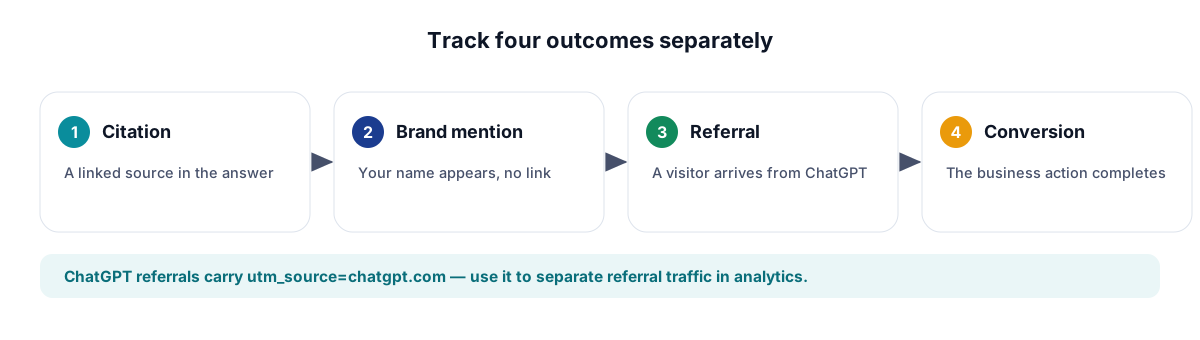
Citation. A linked source in the answer.
Brand mention. The company or product name appears in the answer.
Referral. A visitor reaches the site from ChatGPT.
Conversion. The visitor completes the business action being measured.
ChatGPT referral URLs include utm_source=chatgpt.com. Analytics tools can use that parameter to identify incoming ChatGPT traffic.
For every prompt test, record the exact prompt, prompt group, date, and Search state. Add location when it can change the result.
Also record the cited URL and whether the brand appeared.
A peer-reviewed ACL 2026 study compared Google organic search with five generative-search systems. Those systems came from Google, OpenAI, and Perplexity.
Researchers found substantial differences in source diversity and stability. Results also varied across time and repeated runs.
One citation screenshot therefore represents one observation. It does not establish a permanent source position.
Compare Changed Pages With a Control Group
Change one defined element on 20 pages. Keep 20 similar pages unchanged during the same period.
Then compare the results.
A 2026 natural experiment shows why the control group matters. ChatGPT referrals rose 5.7 times across the site during the study period.
Untreated pages also rose 3.5 times.
The treated-to-control model estimated a 1.82-times increase. Its 95 percent confidence interval was 1.31 to 2.54.
A conservative placebo test returned p=0.16. The authors therefore described the causal result as suggestive, not conclusive.
Platform growth can lift both groups. Compare changed pages with similar unchanged pages before crediting the change.
How to Decide What to Fix Next
Fix the earliest verified problem. Measure again before changing another major variable.
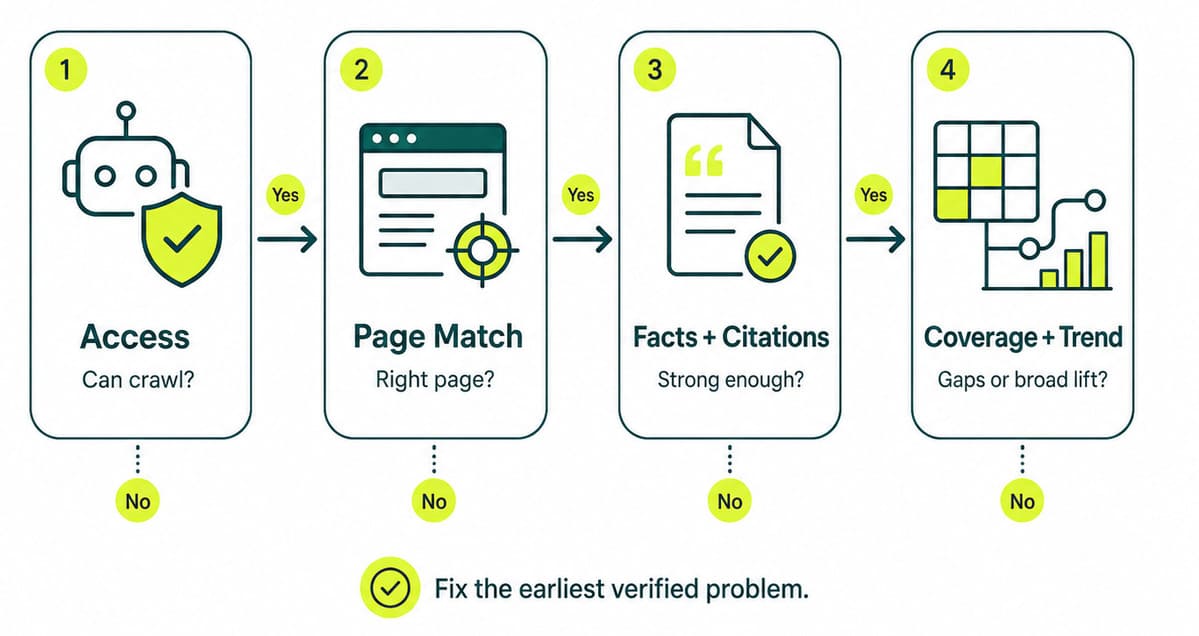
Ask whether OAI-SearchBot can reach the priority page. If not, fix crawler or infrastructure access. Then ask whether another page appears for the target question; if it does, decide which page should answer it and remove the overlap. If the intended page appears but earns no citations, compare its facts, evidence, query match, and competing sources. If one question group performs while related questions fail, check whether the site has a suitable page for those questions. If changed and unchanged pages rise together, check whether wider platform growth explains part of the increase.
When you need to measure cause and effect, change one major variable at a time.
Move From ChatGPT Search Checks to AI Search Optimization
Crawler access is only one part of AI search optimization. SEO Noida’s AI SEO services improve priority pages, content depth, schema, entity facts, source proof, and question coverage across ChatGPT, Google AI, Gemini, and Perplexity.
Conclusion
Start by confirming crawler access. Then fix page targeting, missing facts, unanswered questions, and measurement.
Fix the first verified problem and make one meaningful change. Compare the result with similar unchanged pages before choosing the next change.

Manish Singh is Head of Generative AI at SEO Noida and has 14+ years of experience in SEO, UX, and digital marketing. He focuses on how Google and AI platforms find, interpret, and cite web content. His articles cover AI SEO, GEO, AEO, LLM SEO, entity optimization, content architecture, and visibility measurement, drawing on website audits and campaign work.