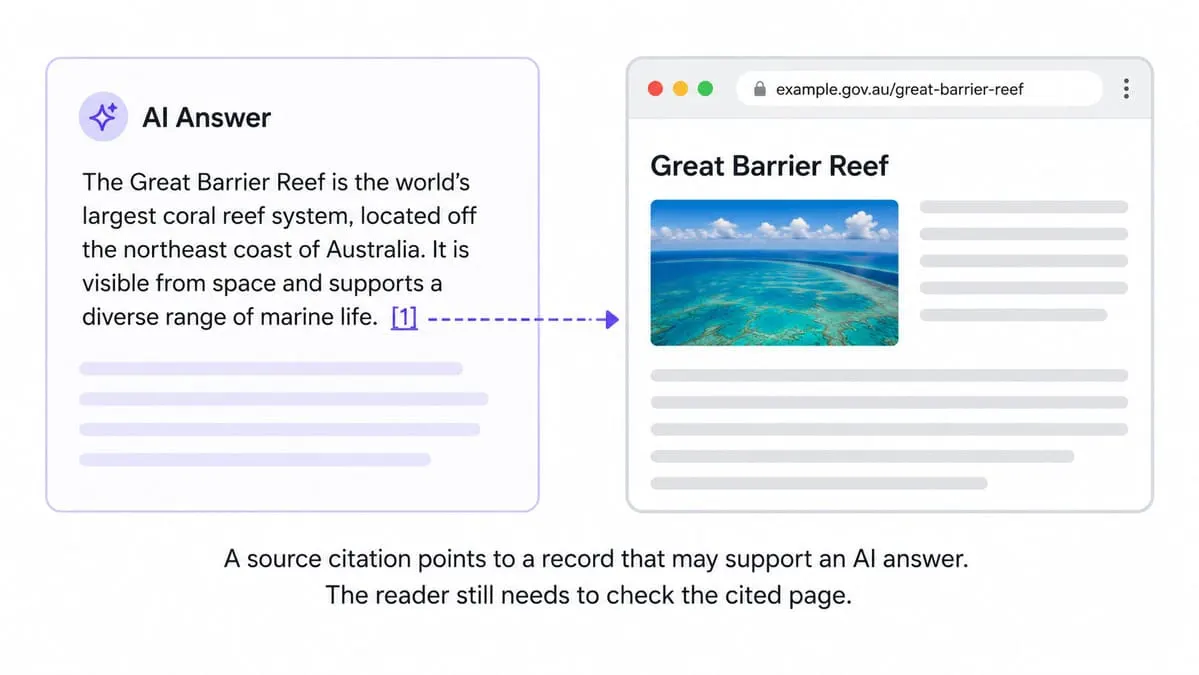
What is source citation?
A source citation is the visible source link an AI answer shows near a claim. The link points to a webpage, document, or record that may support the answer.
Think of a source citation as a receipt beside a statement. The receipt tells you where to check. It does not prove every line in the answer.
Google says AI Overviews and AI Mode can surface relevant links and supporting websites. OpenAI says OAI SearchBot helps surface websites in ChatGPT search results. Perplexity says PerplexityBot surfaces and links websites in Perplexity search results.
A source citation differs from a plain mention. A mention names a brand, page, person, or publisher. A source citation gives the reader a place to check the evidence.
How source citations appear in AI answers
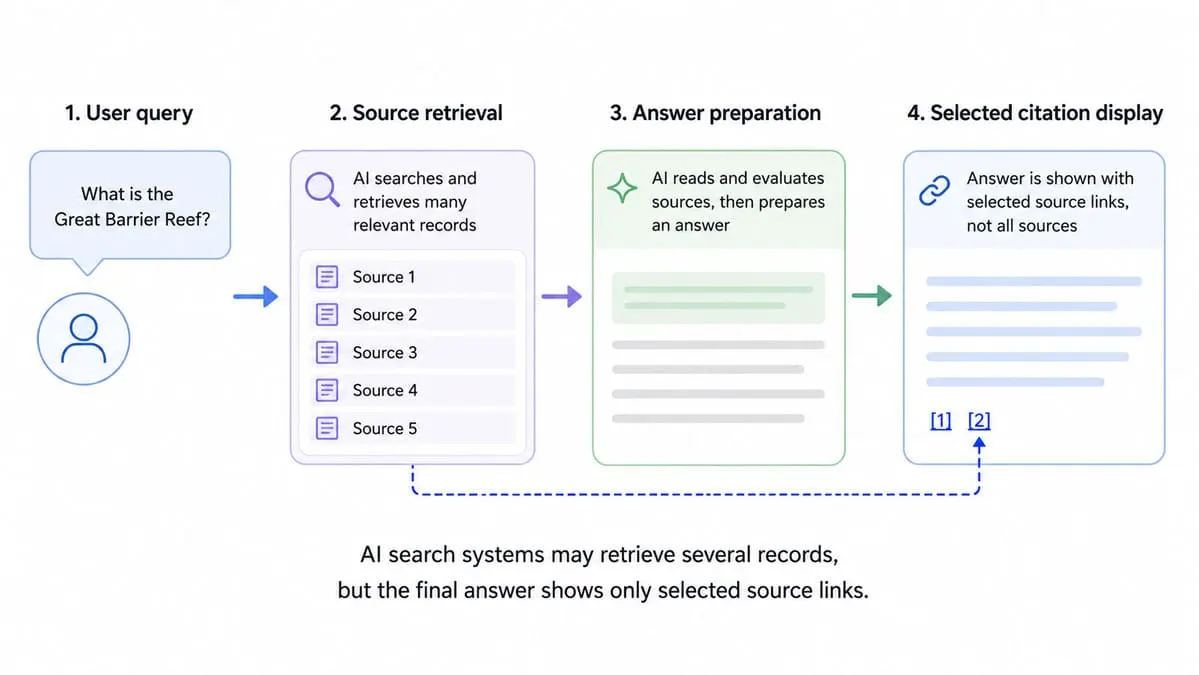
Source citations appear after an AI search system finds candidate sources, prepares an answer, and displays selected links beside that answer.
Google says AI Overviews and AI Mode may use query fan-out. Query fan-out issues related searches across subtopics and data sources. Google also says different AI features may show different response links.
Perplexity says PerplexityBot surfaces and links websites in Perplexity search results. Microsoft says AI Performance reports citation activity across supported AI experiences. Each platform still selects citations through its own system.
The reader sees only the displayed source link. Other retrieved sources may remain hidden.
What a source citation proves
A source citation proves that an AI answer displayed a source link. It does not prove that the cited page fully supports the answer.
This distinction matters. A citation can support one sentence, part of one sentence, or only background context. The reader still needs to open the cited page and compare the claim with the source text.
A 2023 verifiability study audited generative search engines and found weak citation support. The study reported that 51.5% of generated sentences were fully supported by citations, and 74.5% of citations supported their attached sentence.
A 2026 study on Google AI Overviews found that 11.0% of atomic claims were unsupported by cited pages. The same study said cited domains and first-page organic results can differ, which separates citation selection from classic ranking position.
Source citation versus backlink
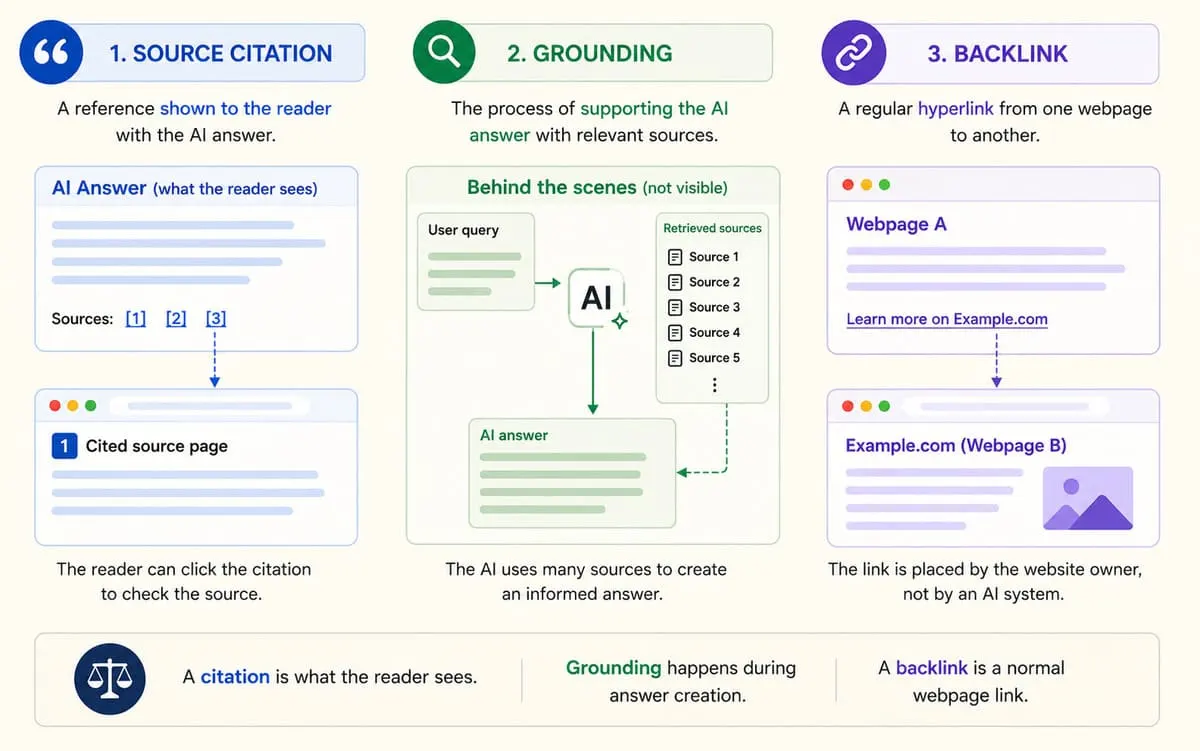
A source citation is a displayed evidence link inside an AI answer. A backlink is a normal hyperlink from one webpage to another webpage.
The difference is practical. A citation helps a reader check an answer. A backlink helps users and crawlers move between webpages.
One URL can receive both. Still, one source citation does not prove a backlink benefit. One backlink does not prove that an AI answer used the page.
Source citation versus grounding
Grounding connects an AI answer to source material during answer creation. Source citation shows a visible source link after the answer appears.
Grounding happens inside the answer process. Citation appears on the screen. A page can help ground an answer without appearing as a visible citation.
The check has two parts. First, check whether the source appeared. Second, check whether the cited source supports the answer.
What publishers should record
A publisher should record each source citation as an evidence record. The record should name the query, platform, date, cited URL, cited claim, and support status.
| Field | What to record |
|---|---|
| Query | The exact search or prompt |
| Platform | Google AI Overview, ChatGPT Search, Perplexity, or Copilot Search |
| Date | The day the citation appeared |
| Cited URL | The displayed source link |
| Cited claim | The answer line linked to the source |
| Support status | Full, partial, background, or unsupported |
Microsoft introduced AI Performance in Bing Webmaster Tools as a public preview on 10 February 2026. Microsoft says the dashboard reports total citations, average cited pages, grounding queries, page-level citation activity, and citation trends across supported AI experiences.
The citation record should separate link presence from proof quality. A page can appear as a cited source and still give only partial support.
Which controls can affect source citations
Publisher controls can affect whether a page can appear as a cited source. Crawl access, index eligibility, and snippet permission all matter.
Google says a page must be indexed and eligible for a snippet to appear as a supporting link in AI Overviews or AI Mode. Google also says no extra technical requirement exists beyond those Search requirements.
Google says site owners can use nosnippet, data-nosnippet, max-snippet, or noindex controls to limit information shown from pages in Google Search AI features.
OpenAI separates OAI SearchBot from GPTBot. OAI SearchBot supports ChatGPT search features. GPTBot supports crawling that may help train foundation models.
Perplexity separates PerplexityBot from Perplexity-User. PerplexityBot surfaces and links websites in search results. Perplexity-User may visit a page after a user request.
How to check citation quality
Check citation quality by matching the AI claim against the cited page. Mark the citation as full support, partial support, background support, or unsupported.
Use this review method:
- Copy the exact AI answer sentence.
- Open the cited source page.
- Find the closest matching source passage.
- Compare the claim with the passage.
- Record the support status.
- Repeat the check on a fixed review date.
A full-support citation backs the claim directly. A partial-support citation backs only part of the claim. A background citation gives context but not direct proof. An unsupported citation fails the check.
How to use source citations during review
Use a source citation as the starting point for verification. Count the citation, open the page, check the claim, and record the support status before using the citation as evidence.
Citation counts can mislead when teams treat links as quality proof. A cited page may appear for a weak reason. A cited page may also support only a small part of the answer.
Use three checks together: citation count, source quality, and claim support. Add referral visits only when traffic data exists. Do not treat a citation as ranking proof.

Manish Singh is Head of Generative AI at SEO Noida and has 14+ years of experience in SEO, UX, and digital marketing. He focuses on how Google and AI platforms find, interpret, and cite web content. His articles cover AI SEO, GEO, AEO, LLM SEO, entity optimization, content architecture, and visibility measurement, drawing on website audits and campaign work.