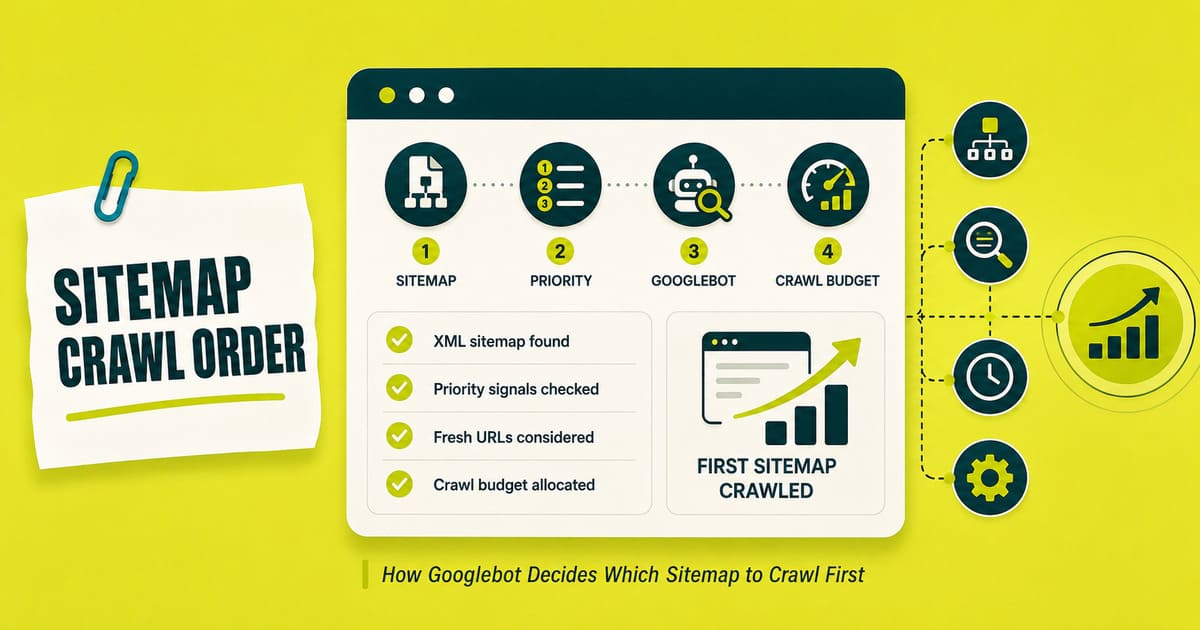
Page URL crawling happens separately after sitemap processing. Crawl budget applies when Google chooses which known URLs it can and wants to crawl. Google defines crawl budget from crawl capacity limit and crawl demand. A sitemap can help Google discover URLs without forcing page crawling.
What Does Which Sitemap Googlebot Crawls First Actually Mean?
Googlebot sitemap crawl order can describe four different events. Google can discover a sitemap URL, fetch the sitemap file, fetch child sitemaps listed inside an index, then crawl page URLs found inside those files.
A sitemap fetch confirms access to the XML file. Search Console Success confirms Google fetched and processed a submitted sitemap. Google then queues successfully parsed URLs for crawling. Queue entry carries no crawl or index guarantee.
A verified page request confirms Googlebot reached that page URL. Indexing comes later after Google fetches and processes the page. Sitemap fetch order and page crawl order therefore answer different questions.
Google also states that URL order inside a sitemap carries no priority value. That rule applies to page URLs inside a sitemap. Google provides no equivalent child-entry ordering rule for a sitemap index.
How Google First Finds and Fetches a Sitemap
Google can discover a sitemap through Search Console, robots.txt, or a sitemap index. Each method changes how Google first learns the sitemap URL.
When You Submit a Sitemap in Search Console
After Search Console submission, Google should fetch the sitemap immediately. Search Console records the submission date and latest successful fetch. Page URLs inside that sitemap can receive different crawl timing afterward.
Google may never crawl some URLs listed in the file. Submitting the sitemap tells Google where the file exists, while page crawling remains a separate decision. Search Console explicitly provides no crawl or index guarantee for discovered URLs.
When robots.txt Lists the Sitemap
Google can discover sitemap URLs from valid robots.txt declarations. Google finds those declarations when it crawls robots.txt. One robots.txt file can list several sitemap URLs.
For example:
Sitemap: https://example.com/sitemap-products.xml
Sitemap: https://example.com/sitemap-articles.xml
Those declarations tell Google where both sitemap files exist. Google documentation provides no priority rule for their declaration order.
When a Sitemap Index Lists Child Sitemaps
A sitemap index lists multiple child sitemap URLs inside one XML file. Each loc element identifies one child sitemap file. Google can fetch each child sitemap separately.
The sitemap index can also contain lastmod for each child sitemap. Those dates describe child sitemap file changes, rather than page changes. Their scheduling value belongs to child sitemap fetching.
How Google Can Schedule Child Sitemaps Inside a Sitemap Index
A sitemap index lastmod may help Google schedule child sitemap fetches. Google defines that value as the modification time for the corresponding sitemap file.
What the Index Level lastmod Records
Index level lastmod records when one child sitemap file changed. The loc element identifies that child sitemap URL. The lastmod value records the child file modification date.
<sitemap>
  <loc>https://example.com/products-sitemap.xml</loc>
  <lastmod>2026-08-25</lastmod>
</sitemap>
Imagine products-sitemap.xml gains twenty newly published product URLs. The child sitemap file changed, which supports updating its index level lastmod. A content edit on one existing product page creates a different event. That page change belongs to URL level lastmod.
Accurate dates matter because Google gives lastmod scheduling value. Changing the date without changing the child sitemap makes that timestamp inaccurate. Neither loc nor index level lastmod guarantees that Google will fetch that child first.
Why the Protocol Supports Incremental Sitemap Fetching
The Sitemap protocol supports incremental child sitemap fetching. A crawler can compare modification dates across child sitemap entries and fetch changed files while leaving unchanged siblings alone.
For example one index containing product, article, and category sitemaps. Only the products sitemap changes after an inventory update. Its modification date changes while both sibling dates remain unchanged. A crawler can fetch that changed subset without fetching every child file again.
Incremental fetching explains the value of child sitemap modification dates. Google still provides no complete formula for ordering eligible child sitemap fetches.
Does Google Crawl the Newest or First Listed Sitemap First?
Google provides no newest-first rule for child sitemaps. Google also provides no first-listed-first rule for child entries. Index level lastmod may help scheduling, but Google publishes no weighting formula.
A newest child sitemap therefore has a potentially useful freshness signal, not a guaranteed first position. Child entry position remains undocumented as a priority factor.
Google gives firmer answers for several related sitemap fields. URL order inside a normal sitemap has no Google priority effect. Google also ignores <priority> and <changefreq>.
Verified server logs can reveal which child sitemap Google fetched first on one site. That observation belongs to that site and measured period. It cannot establish a universal Google rule.
Which Sitemap Signals Google Uses
Google uses accurate page lastmod values and ignores <priority> and <changefreq>. Sitemap index lastmod has a separate file-level scheduling purpose.
How Google Treats priority and changefreq
Google ignores <priority> and <changefreq> values inside XML sitemaps. Neither field controls Google crawl priority or revisit frequency.
A <priority> value of 1.0 cannot force earlier crawling. A daily <changefreq> cannot force daily Googlebot visits. Those fields may remain inside valid XML, but Google ignores their values.
URL lastmod and Sitemap Index lastmod Are Different Signals
URL lastmod and sitemap index lastmod describe different resources.
| Detail | URL level lastmod |
Sitemap index lastmod |
|---|---|---|
| Describes | Significant page update | Child sitemap file update |
| Appears under | url |
sitemap |
| Helps with | Page recrawl scheduling | Child sitemap scheduling |
| Update after | Significant page change | Child sitemap file change |
Google uses page lastmod when the date remains consistently and verifiably accurate. Google considers main content, structured data, and link changes potentially significant. A copyright date change alone does not qualify.
Google uses weaker wording for child sitemap dates. Sitemap index lastmod may help Google schedule sitemap crawling. Keep those two timestamp jobs separate.
Why Historical Google Patents Cannot Prove Current Behavior
Historical Google patents describe crawler designs that used broader sitemap metadata. Older patent material included modification dates, changefreq, and priority.
Those patents describe possible crawler architecture from an earlier period. Current Google Search documentation carries greater relevance for current site decisions. Google now states that it ignores <priority> and <changefreq>.
Historical patents remain useful for crawler design history. They cannot establish current Google implementation details.
Where Crawl Budget Actually Enters the Sitemap Process
The phrase sitemap crawl budget mixes sitemap fetching with page crawling. Google defines crawl budget as the URLs Google can and wants to crawl. Crawl capacity limit and crawl demand determine that budget.
Sitemap processing can happen before later page crawl decisions. A successful sitemap fetch confirms XML access. Page requests remain a separate later crawler decision.
Google calculates crawl budget per unique hostname. For example, www.example.com and code.example.com receive separate crawl budgets.
Advanced crawl budget work mainly applies to large or rapidly changing sites. Google gives rough examples of one million or more unique pages changing weekly, or ten thousand or more unique pages changing daily. Google presents those figures as rough classifications, not exact thresholds.
Crawl Capacity Sets the Host Side Ceiling
Crawl capacity limit caps how much Google crawling a host can support. Google adjusts that limit using server health and connection duration.
Higher latency, 5xx errors, and HTTP 429 responses can reduce capacity. Stable server performance can support more concurrent Google connections. Google also works within finite crawler resources across the web.
Sitemap metadata cannot create extra host crawl capacity. A newer sitemap timestamp cannot compensate for an overloaded server.
How Crawl Demand Influences URL Revisits
Crawl demand reflects how much Google wants to crawl known URLs. Googlebot crawl demand varies with site size, update frequency, page quality, and relevance.
Google also identifies perceived inventory, popularity, and staleness. A larger known inventory gives Google more URLs to consider crawling. Popular URLs tend to receive more crawling, while staleness can encourage recrawling.
Sitemap inclusion can help Google discover page URLs. Crawl demand then influences later crawler activity across those known URLs.
How Sitemap Recrawl Scheduling and Crawl Demand Coexist
Google periodically recrawls a submitted sitemap after a successful fetch. Search Console describes that schedule as independent from the regular site crawl schedule.
Search Console also lists low sitemap crawl demand among sitemap retrieval problems. One statement describes recurring sitemap fetch timing after success. The other shows crawl demand can affect later sitemap retrieval.
Google publishes no formula showing how both conditions interact. Anything more specific would go beyond published evidence.
What Happens After Google Successfully Reads a Sitemap?
Google queues successfully parsed sitemap URLs for crawling. Queueing, page crawling, and indexing remain separate stages.
A known URL can remain unfetched after sitemap discovery. A fetched page can remain outside the Google index. Google can also reread a sitemap without revisiting every listed page.
When Search Console shows Success, Google fetched and processed the submitted sitemap. That status does not confirm page crawling. Verified page logs confirm actual Googlebot requests, while indexing reports show later index outcomes.
How Can You Measure Which Sitemap Google Actually Fetches First?
To check which sitemap Google fetches first, compare verified request timestamps. Server or CDN logs record the local request sequence directly. Search Console Last read adds the latest fetch timestamp for submitted sitemaps.
Use Verified Server or CDN Logs as the Primary Record
A Googlebot user agent alone cannot verify Google crawler identity. Google supports verification through published crawler IP ranges or reverse DNS followed with forward DNS confirmation.
For each sitemap request, record the timestamp, sitemap URL, source IP, HTTP status, and response duration. Those fields show which file Google requested, when the request arrived, and how the server responded.
Imagine only products.xml changed. Google requests it at 10:04, then requests articles.xml at 10:18. Record that sequence as one observed event. Several comparable events can reveal a recurring local pattern.
Use Search Console Last read as Secondary Evidence
Search Console Last read records the latest Google fetch for a submitted sitemap. The Sitemaps report contains files submitted through that report or its API. Sitemaps discovered only through robots.txt do not appear there automatically.
Last read cannot reconstruct every sitemap request between two readings. Use verified logs when exact local fetch order matters.
Measure Child Sitemap Fetch Order With Controlled Observations
A controlled observation can test child sitemap fetch order after a genuine change. Keep the sitemap index structure stable except for the tested child lastmod, then compare later verified requests.
lastmod.A repeated local pattern can support a site-specific conclusion. It cannot establish a universal Google scheduling rule.
What Should You Change When Google Fetches a Different Sitemap First?
Start with the observed problem, then inspect the affected sitemap or page. Google documents no crawl priority from URL order or <priority> values. Current documentation also provides no priority rule for child sitemap entry position.
lastmodcorrect that timestamp.
tie each date to an actual file change.
inspect HTTP responses, robots rules, server availability, and crawler access.
move the diagnosis to page crawling. Inspect crawl capacity, crawl demand, URL inventory, and server health through a broader crawl budget optimization review.
move the diagnosis to indexing.
Once page requests become the issue, sitemap fetch order stops answering it.
Which Sitemap Crawl Order Details Remain Undisclosed
Google leaves several sitemap fetch order details undocumented. Current documentation provides no exact weight for sitemap index lastmod, no child-entry position formula, no ordering rule for several eligible standalone sitemap files, and no complete sitemap scheduling formula.
lastmodAccurate work requires no invented answers. Keep sitemap dates accurate, verify actual Google requests, and report site-specific observations within their measured period. One site can reveal its own fetch sequence without proving universal Google behavior.
Measure verified requests before making sitemap ordering claims.
Measure verified requests before making sitemap ordering claims.
Keep sitemap dates accurate, verify actual Google requests, and report site-specific observations within their measured period.
Sources
https://developers.google.com/search/docs/crawling-indexing/sitemaps/build-sitemap
https://developers.google.com/search/docs/crawling-indexing/sitemaps/large-sitemaps
https://support.google.com/webmasters/answer/7451001
https://developers.google.com/crawling/docs/crawl-budget
https://developers.google.com/crawling/docs/crawlers-fetchers/verify-google-requests
https://www.sitemaps.org/protocol.html
https://patents.google.com/patent/US9355177B2/en

Manish Singh is Head of Generative AI at SEO Noida and has 14+ years of experience in SEO, UX, and digital marketing. He focuses on how Google and AI platforms find, interpret, and cite web content. His articles cover AI SEO, GEO, AEO, LLM SEO, entity optimization, content architecture, and visibility measurement, drawing on website audits and campaign work.