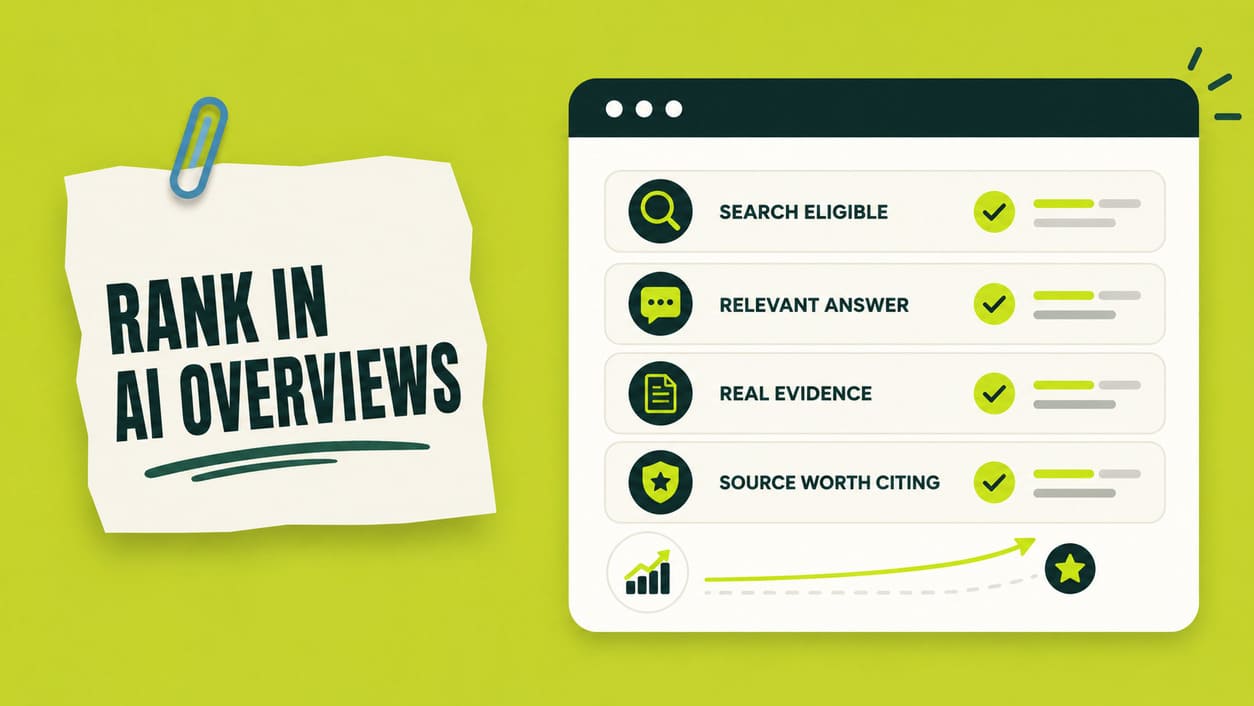
Google current guidance for generative Search confirms that AI Overviews use core Search ranking systems, retrieval-augmented generation, and query fan-out. It also emphasizes unique, useful, non-commodity content.
Here, ranking refers to earning a source citation. Organic position, source citation, and unlinked brand mention are separate outcomes.
Which Queries Show AI Overviews?
Check the queries the page already targets before changing content.
Start with queries connected to important pages, leads, sales, or enquiries. Record each result as a dated observation rather than a permanent query property.
Use a blank record for every priority query:
1 check captures 1 Search result at 1 moment. Recheck priority queries after substantial page edits or visible SERP changes.
When AI Overviews repeatedly appear, inspect their cited URLs. When appearances remain rare, prioritize normal Search performance before AIO-specific work.
No universal public recheck interval exists. Choose frequency from query value, page changes, and visible SERP movement.
The output is practical: a query set showing where citation work deserves attention.
Make the Page Eligible for Google Search
A supporting page needs normal Search eligibility before citation becomes possible.
Google requirements for AI Overview supporting links require an indexed page that can appear in Google Search with a snippet. Google lists no additional technical requirement specifically for AI Overviews or AI Mode.
nosnippet, data-nosnippet, and max-snippet. Restrictive preview controls can limit text available across Search AI features.The Search generative AI control can exclude site links and content from AI Overviews, AI Mode, and covered generative Search features.
Google-Extended serves another purpose. Google crawler information for Google-Extended states that the token controls specified Gemini training and grounding uses. It has no effect on Google Search inclusion and serves no Search ranking-signal role.
Google Search also ignores
llms.txt for Search visibility. Special AI schema creates no extra generative Search eligibility requirement.
Eligibility permits consideration. Citation remains unguaranteed.
Publish Evidence and Analysis Missing From the Reviewed Pages
Keep required background brief. Spend depth on information missing from the 7 reviewed pages.
Google people-first content criteria ask publishers to provide original information, research, analysis, first-hand expertise, and substantial additional value beyond competing pages.
Use 1 deletion test before approving each section.
Schema offers a practical example. Repeating add schema creates little additional value. Comparing observational data with an intervention study creates a stronger information job.
Brand mentions need another correction. Separate brand visibility from page-citation probability before recommending outreach.
Statistics deserve the same treatment. Trace reused numbers to their original dataset. Check sample size, denominator, period, and measured outcome.
If 3 competitor pages repeat 1 secondary article, treat them as 1 evidence origin until the primary source appears.
First-hand expertise belongs where direct experience changes the answer. Decorative experience claims add zero useful evidence.
Answer the Main Question and the Conditions That Change It
Group wording variants under 1 answer. Split content only when the answer changes.
Compare:
Both queries need the same core answer.
Now compare:
Those conditions require different work.
Use this ownership decision:
retain the variation inside existing prose.
create another section when evidence or steps change.
update or link the existing canonical page.
Google confirms query fan-out while warning against separate content for every possible query variation. Its systems can connect relevant pages without exact wording matches.
For example, an existing page covering AI Overview ranking can own a close variation such as Google AI Overview ranking tips. A second URL needs a different reader outcome.
Create another H2 when a condition changes recommendation, evidence, implementation, comparison, or limitation.
Create another URL only when the reader needs a separate result.
More Content Cannot Guarantee More Citations
More words create no citation guarantee.
An Ahrefs word-count study analyzed 1,677,876 cited URLs before retaining 174,048 pages with usable content data. Word count and citation position showed a 0.04 Spearman correlation. The study also found 53.4% of cited pages contained fewer than 1,000 words.
That dataset shows very little relationship between word count and citation position. It cannot establish zero influence from page length on usefulness, relevance, or broader Search performance.
Google also sets no ideal page length or required AI chunk size for generative Search.
Edit through information loss rather than word count.
Focused page
mechanism
evidence
limitation
stop
Overexpanded page
adjacent topic
generic background
repeated advice
delayed evidence
Retain a paragraph when removal would lose evidence, a condition, a comparison, a limitation, or a required step.
Consider an article containing 6 introductory sections before its ranking analysis. Removing definitions, benefits, and repeated background can move evidence closer to the reader question.
Fixed 100-word, 150-word, or 200-word answer targets need direct evidence. Repeated industry advice cannot establish a citation threshold.
Place the answer early because readers need it early. Stop once the section has completed its information job.
Do AI Overview Citations Require a Top-10 Ranking?
No public evidence establishes top-10 direct-query rank as a universal citation requirement.
The July 2025 Ahrefs citation study analyzed 1.9 million citations from 1 million AI Overviews. It focused on the top 3 visible citations and reported 76.1% top-10 overlap.
The March 2026 Ahrefs update used broader citation parsing across 863,000 keyword SERPs and 4 million AI Overview URLs. Among standard blue links, 37.1% ranked in the top 10, 26.2% ranked from 11 through 100, and 36.7% fell outside the direct-query top 100.
The 76.1% and 37.1% figures form no clean same-method trend line. Citation selection, parsing, and the AIO system changed between study periods.
Supported conclusion: top-10 direct-query rank forms no universal citation gate.
Organic Search remains part of generative retrieval. Query fan-out adds another retrieval layer beyond the original wording.
Inference: fan-out may account for part of the gap between direct-query rank and source retrieval. Public research cannot expose the complete internal fan-out query set.
Record organic position during citation analysis. Avoid treating rank as the only explanation.
What Increases AI Overview Citations?
Few page changes have direct intervention evidence for higher citation counts. Separate tested changes, statistical associations, foundational SEO work, and unsupported shortcuts.
Tested change: Schema markup
Schema has stronger intervention evidence than most popular AIO tactics.
An Ahrefs schema experiment tracked 1,885 pages that added JSON-LD between August 2025 and March 2026. Researchers matched them against 4,000 control pages. Google AIO citations changed -4.6% relative to controls. Ahrefs cautions that the result cannot prove schema caused the decline.
The sample already contained heavily cited pages. Effects on pages starting with 0 citations remain unresolved.
Practical decision: retain valid schema for normal Search uses. Avoid adding schema solely for an expected AIO citation increase.
Statistical association: Brand mentions and backlinks
Brand research measures a different outcome.
An Ahrefs study of 75,000 brands found a 0.664 correlation between web mentions and AI Overview brand visibility. Backlinks showed a 0.218 correlation with the same brand-visibility outcome. Ahrefs explicitly separates correlation from causation.
Those numbers cannot show that another mention causes a specific page citation.
Practical decision: earn authentic mentions for brand reach and reputation. Build legitimate links for Search, referral traffic, and authority. Avoid converting either activity into a page-citation forecast.
Foundational Search work: Page experience and internal links
Google includes internal links, page experience, crawlable content, useful media, and accurate structured data among foundational practices relevant to AI features.
Make important pages easy to access and navigate. Link related canonical pages when readers need deeper information.
Improve mobile usability, content visibility, and navigation for users. Avoid treating one page-experience metric as an AIO citation formula.
Trust signals: Authorship and primary evidence
Use a qualified author when expertise affects accuracy or interpretation. Show the author identity and relevant background where readers need that context.
Link primary evidence beside material factual claims. The source should support the sentence scope, number, condition, and qualification.
Authorship can strengthen trust without becoming an isolated AIO citation factor. Google describes E-E-A-T as a collection of quality considerations rather than one specific ranking factor.
Content freshness
Refresh pages when facts, products, policies, studies, or recommendations change.
Changing only the displayed date adds no substantive value. Google people-first criteria explicitly warn against changing dates merely to make pages appear fresh.
Unsupported shortcuts: Fixed answer lengths and FAQ blocks
Current Google guidance sets no required AI chunk size and no ideal page length.
Use the shortest complete answer that preserves necessary conditions. Add another paragraph only when it adds information.
FAQ blocks need the same test. Add them when important reader questions remain unresolved. Avoid generic FAQs inserted only for AIO visibility.
Images and video follow the information job. Add them when they demonstrate, compare, prove, or show something prose handles poorly.
Personalized source preference: Preferred Sources
Google Preferred Sources can place a preferred badge on content from publications selected by individual users. The badge can appear in AI Overviews and AI Mode for those users.
Practical decision: promote the feature to an existing audience where relevant. Avoid presenting personalized preference as a universal ranking increase.
Across these categories, one evidence rule remains critical: frequent appearance on cited pages cannot prove that adding the feature causes citation growth.
Compare Cited Pages With Similar Uncited Pages
Study a cited page beside a comparable uncited page. Winner-only analysis can exaggerate the importance of common page traits.
Choose pages serving the same query intent and similar page type. Match country, observation period, source type, and organic context where practical.
Page type
Source type
Primary evidence
Original data
Conditions covered
Publication date
Organic position
Page type
Source type
Primary evidence
Original data
Conditions covered
Publication date
Organic position
Then record:
possible explanation
evidence needed
Consider a cited page containing the original dataset. Its uncited comparison may repeat numbers from secondary reporting.
Record original data as the observed difference. Treat source depth as a hypothesis requiring more comparisons.
Match publisher articles against similar publisher articles where possible. Match research against similar research.
Comparing unrelated source types creates weak hypotheses. Formatting belongs near the end of the review.
Inspect evidence, source depth, conditions, and information differences first.
Publish Full Data, Methods, or Tools on the Page
An AI Overview can summarize a finding in a few sentences. The source page can contain material that a short summary cannot reproduce fully.
Use a source-depth stack:
Every page needs only the layers required for its purpose.
The schema experiment above illustrates the difference naturally. Its headline result fits inside 1 sentence.
Its treatment dates, control selection, pre-period data, post-period data, and difference-in-differences analysis require more source space.
A calculator creates another source advantage. An AIO can describe the calculation, while the page allows individual inputs.
A dataset works similarly. A generated answer can state a finding, while the source can expose rows, filters, definitions, and collection methods.
Avoid decorative downloads or tools. Every asset needs a reader task.
Does the Citation Support the Generated Claim?
A source link cannot prove every nearby generated statement is accurate. Compare each material claim against the cited source.
Use 5 support states:
An under-review 2026 AI Overview claim-fidelity study analyzed 98,020 atomic claims. Researchers reported 11.0% unsupported claims under the study framework. The sample covered 55,393 trending queries across 19 categories during a 40-day observation window.
The finding belongs to that sample and method. It cannot become a universal Google error rate.
For an internal audit, save the generated claim, cited URL, supporting passage, observation date, and support classification together.
Citation presence and citation accuracy require separate records.
Measure Impressions, Citations, Clicks, and Conversions Separately
Impressions, citations, clicks, visits, and conversions record different events.
Search Console counting rules for AI Overviews state that clicking an external AIO source link counts as a click. A source receives an impression after scrolling or expansion makes the link visible. Every link inside 1 AI Overview receives the same Search position.
The Generative AI performance report adds a separate impression view for eligible properties. It currently includes AI Overviews and AI Mode and supports page, country, date, and device dimensions.
Report the metrics separately:
Every number needs a source and denominator.
A citation count needs a declared query sample. A conversion count needs analytics or CRM records.
When assessing a page change, record the edit date and page version. Compare the same metric before and after the edit.
A stronger test also includes comparable untreated pages where practical. Basic before-after movement cannot establish the cause.
What We Cannot Prove About AI Overview Rankings
Public evidence leaves several important questions unresolved:
Google explicitly states that third-party tools have no access to its internal ranking or AI systems.
Use observable page states, primary evidence, current Google sources, and measured outcomes.
Start with eligibility, relevance, and evidence
Here, ranking refers to earning a source citation. Organic position, source citation, and unlinked brand mention are separate outcomes.

Manish Singh is Head of Generative AI at SEO Noida and has 14+ years of experience in SEO, UX, and digital marketing. He focuses on how Google and AI platforms find, interpret, and cite web content. His articles cover AI SEO, GEO, AEO, LLM SEO, entity optimization, content architecture, and visibility measurement, drawing on website audits and campaign work.