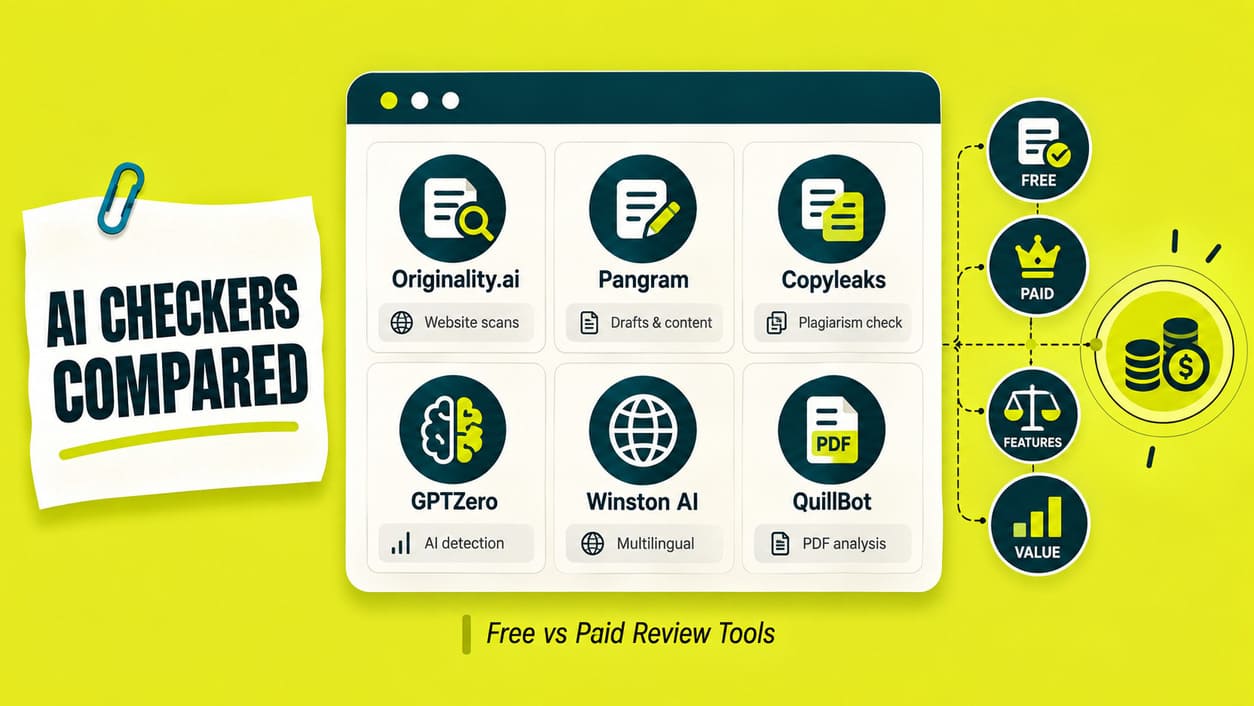
Choose an AI checker for article reviews, website scans, or writing-history checks. An AI content checker estimates possible AI use from patterns within your text. Its score cannot replace source checks or a factual review. Compare article limits, subscription costs, and permission to upload client drafts. Separate questions about AI use from errors in the article.
Takeaways
Compare the six AI checkers
Compare the full price of the check you need. Entry plans may exclude website scans, shared accounts, or downloadable reports.
| Tool Review task Price or free access Check before paying | |||
|---|---|---|---|
| Originality.ai | Articles across a website | Pro: US$14.95/month; extra accounts: US$9.95/month each | Plagiarism checks and rescans consume additional credits |
| Pangram | Human and AI-assisted drafts | Free: 2,000 words/day; Individual: US$20/month | Team requires at least two paid accounts |
| Copyleaks | Multilingual text and shared website checks | Personal: US$16.99/month; Pro: US$99.99/month | Website scanning and 25 accounts require Pro |
| GPTZero | Recorded Google Docs writing activity | Free access; current paid prices and exact allowances unconfirmed | Reports depend on captured writing activity |
| Winston AI | PDFs and scanned documents | Essential: US$18/month; Advanced: US$29/month | Plagiarism and team access require Advanced |
| QuillBot | Occasional complete-text checks | Free: 80–1,200 words/scan; up to six scans/day | Check the maximum article length before uploading |
Prices checked 9 September 2026. Amounts use USD. Monthly billing applies unless an annual payment is shown.
Prices and features come from current provider pages. Study findings appear only where they help interpret detector results. No six-tool hands-on accuracy test was performed.
Before uploading: Confirm client permission before submitting unpublished drafts to any external checker.
1. Originality.ai: Check articles across a website
Originality.ai Pro scans individual articles and pages across a website. Project tags group reports from the same content project. Pro scan reports remain accessible for 30 days.
Pro prices and checking limits
Pro costs US$14.95 monthly and includes 2,000 monthly credits. Annual payment costs US$155.40 upfront, equal to US$12.95 per month.
Each credit covers 100 words with AI detection alone. Adding plagiarism checking doubles that charge to two credits per 100 words. At full use, 2,000 credits can cover up to 200,000 AI-only words. Combining AI detection with plagiarism checking reduces the allowance to 100,000 words.
Credit expiry and rescans
Extra accounts and software access
AI Allowance
2. Pangram: Review drafts written with AI help
Pangram estimates AI assistance within drafts containing human and generated writing. AI proofreading changes existing text; generation creates new passages.
What the Pangram study found
Researchers compared four detectors across 160 academic documents written in English. Every study document contained at least 4,000 words. Mixed documents combined student paragraphs with AI-generated sections.
Researchers compared detector scores with the known proportion of generated text. Pangram fell within their accepted scoring range for 37 of 40 mixed documents. Researchers generated study samples in May 2025, before the June 2026 publication. Pangram released version four on 29 July 2026, after publication. Those results cannot establish how newer Pangram versions perform on SEO articles.
Free, Individual, and Team access
3. Copyleaks: Check multilingual articles
Copyleaks supports over 30 languages for AI detection, compared with over 100 for plagiarism. Check that Copyleaks supports the specific check and text your article needs.
Checking translated passages
Copyleaks Pro checks source matches across original and translated text. A translated match identifies similar source material, without proving an AI origin. Review matching passages for quotations and credit to the original source. Check translated claims against evidence in the original source. Neither cited study tested AI detection on translated commercial website articles.
Personal or Pro
4. GPTZero: Review the writing history of a draft
GPTZero reports show recorded Google Docs edits, pasted blocks, and contributions from other writers. The report covers only activity the recording system captured.
Using the writing report
Match the report with the exact article version you received. For a pasted paragraph, ask where the writer prepared that text. Offline drafting can leave part of the history missing. Export the writing report as a PDF for another reviewer.
Before paying for GPTZero
5. Winston AI: Review PDFs and scanned documents
Winston AI accepts document uploads and extracts scanned text through OCR. OCR converts scanned words into editable text for review.
Check extracted text before reading the score
Read the Human Score
Trial and paid allowances
Unused credits expire after each monthly billing cycle. Your selected checks determine how many credits each scan consumes. Compare report access and document volume before paying for Winston.
6. QuillBot: Check text without a paid plan
The QuillBot AI detector offers free scans within the published word limits. Each free submission requires between 80 and 1,200 words. Free users can make up to six detector scans each day.
What the free result includes
Averaging passage scores cannot replace a check of the complete article. For longer drafts, choose a tool accepting the complete article.
Longer drafts and free alternatives
Does a high AI score mean a Google penalty?
An AI detector score cannot establish a Google penalty. Google publishes no safe detector percentage in its content guidance. A detector score cannot identify the cause of declining organic rankings.
What Google focuses on
Google describes AI as useful for researching topics and preparing original website content. Publishing many low-value pages primarily to manipulate rankings can breach Google Search spam policies. Google calls that practice scaled content abuse. The policy covers automated writing, human writing, and combinations of both.
Why AI checkers return different results
AI checkers use different score models and definitions. A false positive occurs when a checker wrongly flags human writing. Missing AI-generated text produces the opposite error, a false negative. Text length and later edits can change the result.
Check what the score measures
A confidence score estimates how certain the detector is about its label. It cannot confirm the exact share of AI-written words. Record document version, detector model, and mode before comparing scores.
Why one accuracy ranking would be misleading
Before trusting an accuracy claim, check the writing sample, edits, and detector version. Matching scores remain predictions when several detectors agree. A 2023 study found false flags among some non-native English writing samples. The study establishes no current error rate for these six tools. Nationality and polished writing alone cannot prove AI use.
Should you scan titles and meta descriptions?
Review titles and meta descriptions for accuracy, relevance, and unsupported promises. Short passages offer less context for the detector to assess.
Short-text checks
Check privacy before uploading client content
Confirm client permission before uploading unpublished work to an external AI content checker. Check who stores the draft, accesses it, and uses it for training. Ask how long backup copies remain after you delete a report.
GPTZero website and API submissions
GPTZero stores dashboard text and uses grouped data to improve its service. An API sends article text directly from other software to GPTZero. GPTZero defaults to zero content storage for direct API subscribers. Subscribers can enable storage when they need submitted text inside the application. Its privacy policy excludes direct API text from use in improving its products.
Winston storage and deletion
Winston excludes scanned documents from detector training under its published policy. It stores submitted content while the corresponding report remains.
Winston commits to deleting active copies within 30 days after account or report deletion. Encrypted backups may retain deleted text for up to 90 additional days after active removal. Legal requirements can extend storage beyond those periods.
Before uploading any client draft
Pause uploads until the person responsible for client permission answers every open question. Removing names alone cannot override a client restriction on external uploads.
What to do when an AI checker flags your draft
Identify the exact concern before asking the writer to revise. Check factual errors separately from questions about the agreed writing process. A factual error needs supporting source evidence. A writing-process question needs the original brief and available draft history.
Check the flagged passages against the agreed brief
Start with the scanned draft version and original AI-use agreement. Check which AI assistance the brief permits and requires the writer to disclose. Avoid stricter AI-use rules after reviewing a detector score.
Check the article itself
Choose: publish, revise, ask, or hold
Publish when evidence resolves the concern and the draft meets the agreed brief. Revise identified errors, ask focused questions, or hold drafts awaiting essential evidence.
| Decision When to choose it What to record | ||
|---|---|---|
| Publish | Evidence resolves the concern; the article meets the brief and editorial checks | Approval reason and supporting evidence |
| Revise | A factual error, unsupported claim, repeated point, or unanswered question remains | Exact passage and required change |
| Ask | A specific question remains about the permitted AI use | Passage, original agreement, and focused question |
| Hold | A required source, permission, or publication condition remains unresolved | Missing evidence, responsible reviewer, and next action |
Questions about the writing process
Ask the writer about the passage and agreed AI-use rule. Consider available drafts, source notes, and the writer response before deciding. Missing records alone cannot prove that the writer broke the original agreement.
Assign the remaining decision to the person authorised to approve publication. Consider another detector only when its output could answer the remaining review question. Skip another scan when its result cannot change the publishing decision.
Record the reason and stop rescanning
When is an AI checker worth paying for?
Pay when free tools cannot check the whole article or support your reviewers. Include additional accounts and repeat scans in the full subscription cost. Free access can cover occasional checks within its published limits.
More credits increase scanning capacity without proving stronger detection. Follow existing AI disclosure agreements before removing routine detector checks.
Paid plans may add larger inputs, shared accounts, reports, or plagiarism checks. Choose the lowest plan that includes the feature your review needs. Free access remains useful when its limits cover your permitted document. Another detector score adds little when it cannot change the final publishing decision.
